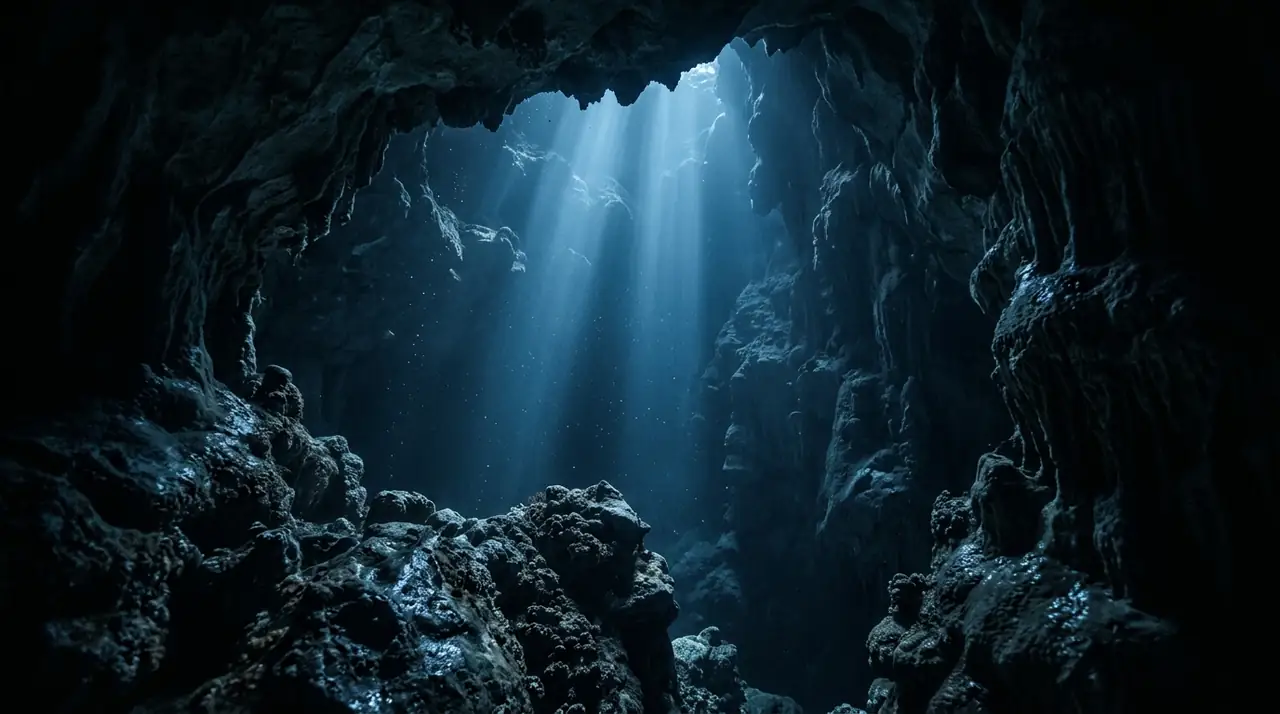
Vis Submarine Shelter
Overview
The Vis Submarine Shelter is one of the most unusual dive sites in the Mediterranean, a Cold War relic where Yugoslav military engineering meets underwater exploration. During the decades when Vis Island served as a closed military zone, engineers carved massive tunnels into the limestone cliffs to conceal submarines from aerial reconnaissance. When Croatia gained independence and the military withdrew, these tunnels were left to the sea. I entered the water near the tunnel mouth on the southeastern coast, descending to around 10 metres where the dark rectangular opening immediately commands attention. Swimming into the tunnel, the temperature drops slightly and ambient light shifts to deep blue-green as overhead rock closes in. The tunnel is remarkably spacious — designed for a submarine, it is wide enough for several divers abreast and tall enough that there is no confinement. Shafts of light penetrate from the entrance and through cracks above, creating ethereal conditions that photographers dream about. The walls tell two stories simultaneously. Smooth concrete surfaces speak of industrial-scale military construction, with bolt holes and rusted fittings visible in the torch beam. But nature has been reclaiming the space: sponges in vivid orange and yellow encrust the concrete, cardinal fish hover near the ceiling, and shrimps retreat into crevices. Octopuses have made homes in old mooring fixtures, and moray eels occupy gaps where concrete meets natural rock. Emerging from the far side, the reef along the outer cliff face provides a beautiful second act. Sea bream school in open water, blennies peer from holes, and visibility reaches 15 to 25 metres on typical summer days. Vis Island has a haunting quality — Tito's wartime headquarters, closed to tourists for 45 years, its isolation preserved both cultural heritage and marine environment. Diving the submarine shelter is a journey through twentieth-century history as much as an underwater adventure.
Early access
Plan a dive here
Open the DiveOne planner to sketch a recreational plan before you go. It is a planning assistant, not a dive computer.
Marine life
Dive profile
DEPTH PROFILE
DEPTH PROGRESSION & WAYPOINTS: Vis Submarine Shelter
Location
Frequently asked questions
What is the history of the Vis Submarine Shelter?
During the Cold War, the Yugoslav People's Navy carved several underground military tunnels into the limestone cliffs of Vis Island to shelter submarines and fast patrol boats from aerial detection. The island served as a major military base and was closed to foreign visitors until 1989. After Croatian independence, the tunnels were abandoned and have since been colonised by marine life, creating a unique fusion of military history and underwater ecology.
What certification do I need to dive the submarine shelter?
An Open Water certification is technically sufficient as the tunnel maintains natural light throughout and the maximum depth is around 22 metres. However, Advanced Open Water or cavern diving experience is recommended because parts of the tunnel are enclosed overhead. All divers must be accompanied by a local guide who knows the structure and any hazards from deteriorating concrete and metal.
Is the submarine shelter a cave dive or a cavern dive?
It is classified as a cavern dive rather than a true cave dive because natural light is visible throughout the tunnel from one or both entrances. The tunnel is wide and tall enough that a submarine could pass through, so there is ample space for divers. No cave diving certification is required, but comfort with overhead environments and good buoyancy control are essential to avoid stirring up silt from the tunnel floor.
Reviews
Reviews
No reviews yet
Data Provenance
This profile is compiled from 3 operator submissions and 142 community logs. Key facts (depth, entry) are verified against official hydrographic charts.