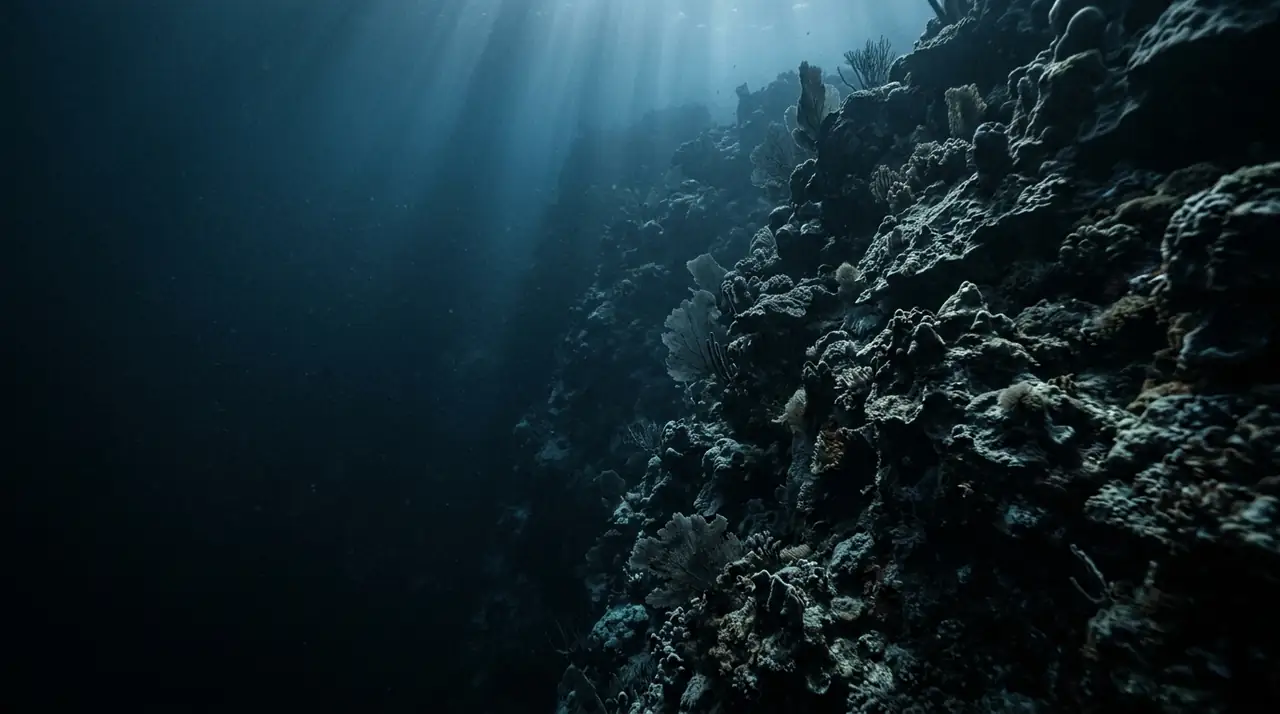
Verde Island Wall
Overview
Verde Island Wall is the premier wall dive in what scientists have confirmed as the global epicentre of marine biodiversity. Verde Island itself sits in the centre of the Verde Island Passage, the narrow strait between Luzon and Mindoro where a 2005 California Academy of Sciences expedition documented more marine species per unit area than anywhere else on Earth. The southeastern wall of the island drops sheer from a shallow reef crest into the passage's deepest channel, concentrating this extraordinary biodiversity into a single vertical structure. The boat ride from Batangas City takes 45 minutes across the busy shipping lane of the passage. Verde Island rises from the water as a forested hill, its shores fringed by coral reef. On the southeastern face, the reef crest at 3 to 5 metres gives way abruptly to a vertical wall that plunges beyond recreational diving limits into the 200-metre depths of the central channel. Descending over the wall edge, the diversity of life is immediately overwhelming. Hard corals in over 300 documented species create a three-dimensional maze of plates, branches, and massive domes. Sea fans stretch two metres across, their surfaces alive with pygmy seahorses, nudibranchs, and commensal shrimp. Soft corals in every conceivable colour fill the gaps between hard coral colonies, and clouds of anthias in pinks and oranges swarm above every outcrop. The wall's exposure to deep-water currents flowing through the passage brings pelagic visitors that elevate dives from excellent to extraordinary. Devil rays sweep along the wall face in groups of three to seven, their wingspan exceeding three metres. Thresher sharks have been documented at depth, using their elongated tails to stun prey fish against the wall. During full moon tides, hammerhead sharks occasionally appear in the blue water beyond the wall edge. Midway along the wall, overhangs and small caves provide shelter for resting whitetip reef sharks and large groupers. Napoleon wrasse of impressive size patrol the wall with the unhurried confidence of apex reef residents. Schools of big-eye trevally form silvery walls that mirror the rock face behind them. Verde Island Wall demands respect for its currents and depths, but rewards advanced divers with what may be the most biodiverse single wall dive on the planet. Its proximity to Manila, just three hours by road and boat, makes it one of the few world-class wall dives accessible as a day trip from a major capital city.
Early access
Plan a dive here
Open the DiveOne planner to sketch a recreational plan before you go. It is a planning assistant, not a dive computer.
Marine life
Dive profile
DEPTH PROFILE
DEPTH PROGRESSION & WAYPOINTS: Verde Island Wall
Location
Frequently asked questions
How is Verde Island Wall different from Verde Island Passage?
Verde Island Passage refers to the entire strait between Luzon and Mindoro, recognized as the global center of marine shore-fish biodiversity. Verde Island Wall is a specific dive site on the southeastern face of Verde Island itself, where a vertical wall drops from 5 metres to beyond 60 metres into the deepest part of the passage. The wall concentrates the passage's famous biodiversity into a single dramatic structure accessible by boat from Batangas City.
What currents should I expect at Verde Island Wall?
Currents at the wall can be powerful, driven by tidal exchange through the passage between the Pacific and South China Sea. Strong currents bring nutrients and attract pelagics but require advanced skills. Dive operators time descents with current predictions and the wall can be dived as a drift. Down-currents along the wall face are possible and divers should be prepared to ascend away from the wall if necessary.
What makes this area the center of marine biodiversity?
A 2005 scientific survey by the California Academy of Sciences confirmed Verde Island Passage as having more marine shore-fish species per unit area than anywhere else on Earth. The passage sits at the apex of the Coral Triangle where currents from the Pacific and South China Sea converge. Over 1,700 fish species and 300-plus coral species have been documented in this relatively small strait.
Reviews
Reviews
No reviews yet
Data Provenance
This profile is compiled from 3 operator submissions and 142 community logs. Key facts (depth, entry) are verified against official hydrographic charts.