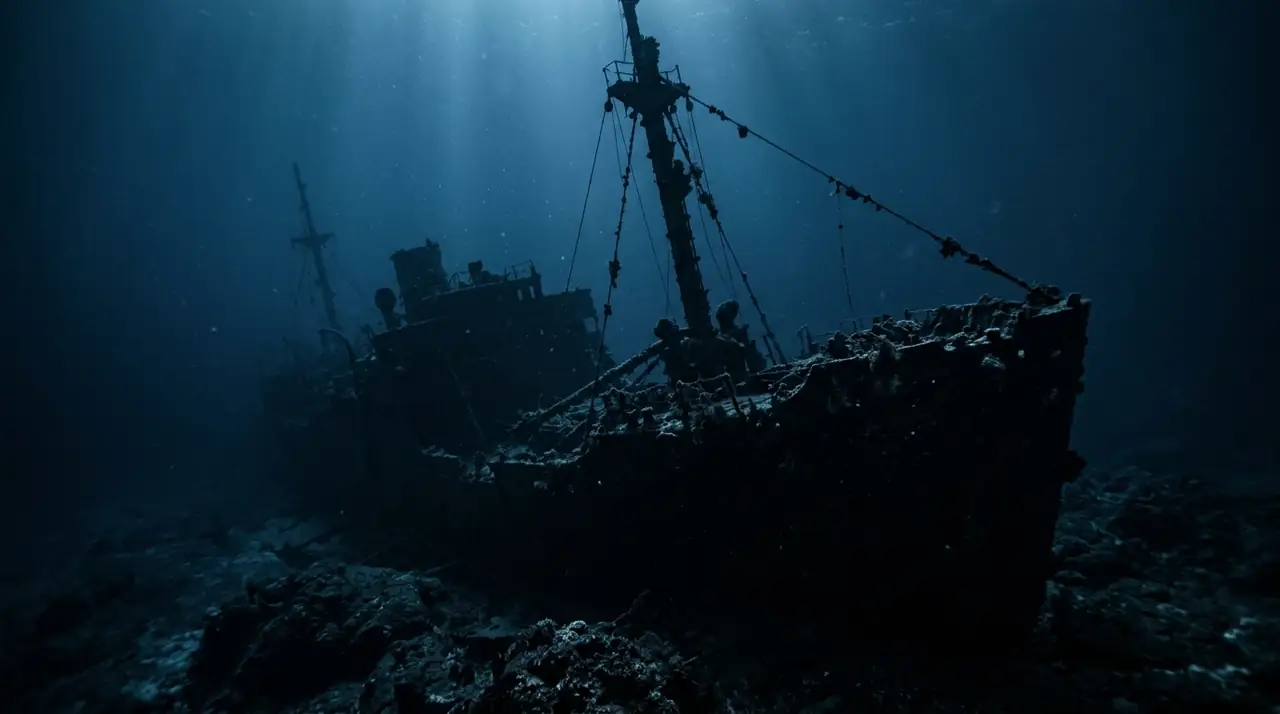
USS Schurz Wreck
Overview
The USS Schurz lies thirty-four metres down off Cape Lookout, North Carolina, one of the hundreds of wrecks that earned this coast its Graveyard of the Atlantic name. The Schurz stands apart in historical significance. Originally SMS Geier, a German Imperial Navy light cruiser built in 1894, the ship served under two flags before a collision sent it to the bottom in June 1918. The boat ride from Morehead City took ninety minutes. We geared up with double tanks, and the briefing covered penetration routes and the wreck's layout. Descending the mooring line, the wreck emerged from green-blue water at twenty-five metres, her hull lying on its port side. At over 80 metres long, the Schurz stretches beyond visibility in both directions, steel hull encrusted with decades of marine growth. Sponges in orange and yellow covered every surface. I entered through a hull breach amidships, penetrating into the engine room where machinery remains recognisable. Pipes and valves lined the bulkheads. A large dial, its face illegible after a century underwater, remained mounted on a panel. The space was large enough for comfortable navigation, natural light filtering through multiple openings. Outside, the sand tiger sharks were waiting. Three individuals hung motionless off the stern, their ragged teeth visible at distance. These sharks are the signature species of North Carolina's wreck diving, using artificial reefs as rest stops during coastal migrations. Their presence transforms a historical dive into something visceral. Schools of amberjack circled the wreck's upper surfaces. Spadefish gathered around the masts. Sea bass and sheepshead occupied smaller structural gaps. The wreck has become a thriving artificial reef, the German-American vessel now serving a third purpose as habitat. The Schurz asks divers to hold two realities simultaneously. It is early twentieth-century naval engineering, a machine designed for war that experienced ironic peace. And it is a living reef, the steel skeleton becoming indistinguishable from the organic community it supports.
Early access
Plan a dive here
Open the DiveOne planner to sketch a recreational plan before you go. It is a planning assistant, not a dive computer.
Marine life
Dive profile
DEPTH PROFILE
DEPTH PROGRESSION & WAYPOINTS: USS Schurz Wreck
Location
Near Morehead City, in the North Carolina region of United States.
Frequently asked questions
What is the history of the USS Schurz?
The USS Schurz has one of the most unusual histories of any diveable wreck. Originally built in 1894 as SMS Geier, a German Imperial Navy unprotected cruiser, the ship was interned in Hawaii at the start of World War I when it entered Honolulu harbour for repairs. When the United States entered the war in 1917, the ship was seized and commissioned into the US Navy as USS Schurz. On June 21, 1918, the vessel collided with a merchant ship SS Florida off Cape Lookout, North Carolina, and sank with the loss of one crewman.
What certification is needed to dive the USS Schurz?
The wreck sits at approximately 34 metres, requiring Advanced Open Water certification at minimum. For penetration diving, wreck diving speciality certification is strongly recommended. The site can experience moderate current, and visibility varies. Most operators require documented experience at depth and a minimum number of logged dives. Nitrox certification is valuable for extending bottom time at this depth. The boat ride from Morehead City takes approximately two hours depending on sea conditions.
Are sand tiger sharks present on the wreck?
Sand tiger sharks are commonly found on and around the USS Schurz, particularly from May through October. These sharks aggregate on North Carolina's wrecks during the warm season, using the structures for shelter and hunting. Despite their fearsome appearance with visible protruding teeth, sand tiger sharks are generally docile toward divers. Multiple individuals are often present on a single dive, sometimes resting inside the wreck structure. Their presence adds a memorable dimension to what is already an historically significant dive.
Reviews
Reviews
No reviews yet
Data Provenance
This profile is compiled from 3 operator submissions and 142 community logs. Key facts (depth, entry) are verified against official hydrographic charts.