USS Oriskany
Overview
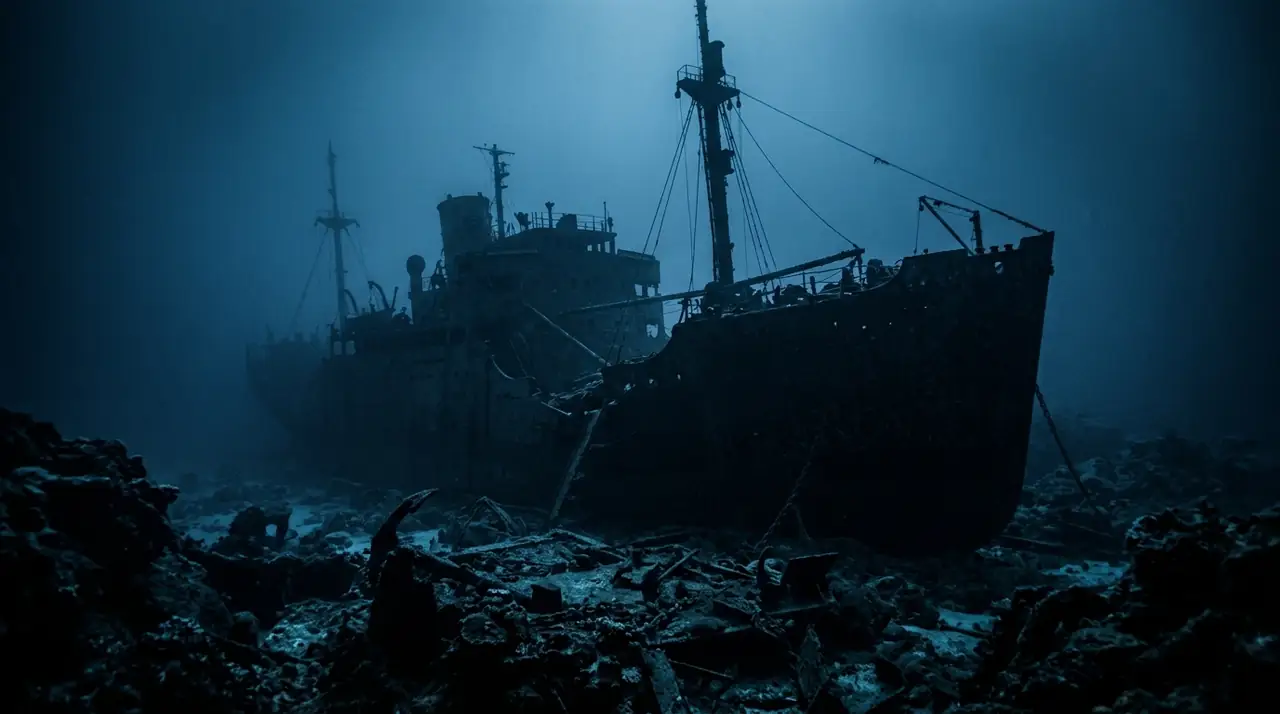
The USS Oriskany lies on the sandy bottom of the Gulf of Mexico roughly 35 kilometres south of Pensacola, Florida, a 270-metre Essex-class aircraft carrier deliberately sunk in 2006 to create the world's largest artificial reef. The Navy called the project the Great Carrier Reef, and nearly two decades later the name has proved prophetic. This massive warship, which launched jets during the Korean and Vietnam Wars, has been completely transformed by marine life into a living reef of extraordinary proportions. The boat ride from Pensacola takes about an hour, and the first hint of the wreck is your dive computer showing the bottom rising from 60-plus metres to 20 metres as the superstructure appears on the sonar. I rolled backwards into warm Gulf water and began my descent. The sheer scale of the Oriskany is the first thing that overwhelms. This is not a fishing trawler or a tugboat. It is an aircraft carrier, and even at twenty metres visibility, the structure extends beyond sight in every direction. The island superstructure, where the ship's command bridge once directed flight operations, now rises to within 20 metres of the surface. Its radar masts and antenna arrays are thickly encrusted with soft corals, hydroids, and sponges, while enormous schools of Atlantic spadefish, numbering in the hundreds, wheel around the structure in hypnotic formations. Great amberjack, powerful silver predators each over a metre long, patrol the upper levels in aggressive packs. Descending to the flight deck at 24 metres, the wooden planking is long gone, leaving steel frameworks that form an intricate lattice of swim-throughs and openings. Goliath groupers, some exceeding 150 kilograms, have made the deck their domain. They hover in the openings with a placid authority that belies their enormous size. Red snapper and triggerfish crowd every horizontal surface, and great barracuda hang motionless in the water column, their silver bodies reflecting the filtered Gulf light. The hangar deck openings at around 40 metres beckon the deeper-rated diver into cavernous internal spaces where the carrier's aircraft once parked wingtip to wingtip.
Early access
Plan a dive here
Open the DiveOne planner to sketch a recreational plan before you go. It is a planning assistant, not a dive computer.
Marine life
Dive profile
DEPTH PROFILE
DEPTH PROGRESSION & WAYPOINTS: USS Oriskany
Location
Frequently asked questions
What certification level do I need to dive the USS Oriskany?
The shallowest point of the wreck, the top of the island superstructure and the mast, sits at approximately 20 metres. The flight deck is at 24 metres, and the hangar deck openings are around 40 metres. Advanced Open Water certification is the minimum required to dive the flight deck level. Reaching the hangar deck and deeper structures requires deep diving experience or technical diving certification. The ship's keel rests at 64 metres on the sandy bottom, firmly in technical diving territory. Most recreational divers focus on the island superstructure and flight deck, which offer exceptional marine life encounters without the need for decompression stops.
How was the USS Oriskany prepared for sinking as a reef?
The USS Oriskany was an Essex-class aircraft carrier commissioned in 1950 that served in the Korean and Vietnam Wars. After decommissioning, the Navy spent years preparing the ship for its role as an artificial reef, removing hazardous materials including PCBs, fuel, and asbestos at a cost of over 20 million dollars. The carrier was sunk on 17 May 2006, approximately 35 kilometres south of Pensacola in the Gulf of Mexico. The sinking was televised live and the ship took 37 minutes to settle on the bottom. It was the largest vessel ever intentionally sunk as an artificial reef at the time.
What conditions should I expect when diving the Oriskany?
Conditions in the Gulf of Mexico are variable. Visibility ranges from 10 to 30 metres, with the best clarity typically from June through August. Currents can range from negligible to strong, and the boat ride takes 45 to 90 minutes from Pensacola depending on the vessel. Summer brings the warmest water temperatures of 28 to 30 degrees Celsius at the surface, though thermoclines can drop temperatures significantly at depth. Surface conditions can deteriorate quickly, so trips are weather-dependent. Dive operators typically run morning departures and the site allows two dives per trip.
Reviews
Reviews
No reviews yet
Data Provenance
This profile is compiled from 3 operator submissions and 142 community logs. Key facts (depth, entry) are verified against official hydrographic charts.