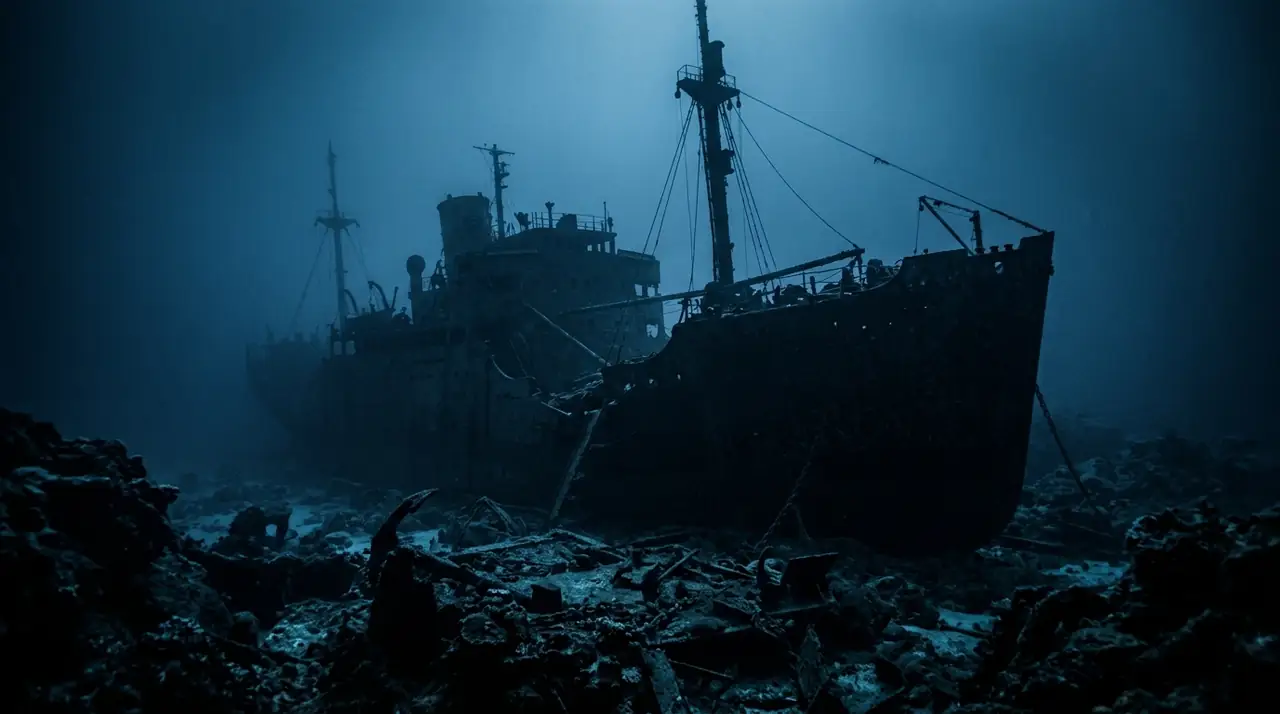
Stavronikita Wreck
Overview
The Stavronikita is Barbados' signature dive and one of the Caribbean's most impressive artificial reef wrecks. This 111-metre Greek freighter was deliberately sunk off the west coast in 1978 after a devastating fire destroyed her cargo of cement two years earlier. Nearly five decades underwater have transformed the steel hull into a living cathedral of coral, sponges, and marine life that few purpose-sunk wrecks can rival. Descending the mooring line, the superstructure emerges from the blue starting at around 20 metres. The masts, davits, and bridge windows are thickly encrusted with hard corals, tube sponges, and gorgonians, creating a colourful tapestry that softens the ship's industrial lines. Hawksbill turtles frequently rest in the shelter of the superstructure, and on my last dive here a large green moray eel peered from a porthole with characteristic nonchalance. Moving down to the main deck at 36 metres, the vessel's scale becomes apparent. The cargo holds yawn open, allowing natural light to illuminate schools of horse-eye jacks circling endlessly inside. Barracuda patrol the wreck's perimeter, and dense schools of silversides sometimes fill the holds in shimmering clouds. The hull plates are covered in encrusting corals, with coral banded shrimp and arrow crabs occupying nearly every crevice. Patient divers may spot well-camouflaged frogfish clinging to sponge colonies. The seabed sits at 42 metres, and exploring the full depth demands respect for nitrogen narcosis and careful gas management. Most operators run the dive as a deep single-tank, allowing around 20 minutes of bottom time before ascending. Visibility ranges from 15 to 25 metres, with the best conditions between December and May. The boat ride from Bridgetown takes about fifteen minutes, and the Stavronikita is frequently combined with a shallower second dive nearby. For certified deep divers seeking a wreck with genuine character and decades of natural coral growth, the Stavronikita delivers far beyond the typical purpose-sunk vessel.
Early access
Plan a dive here
Open the DiveOne planner to sketch a recreational plan before you go. It is a planning assistant, not a dive computer.
Marine life
Dive profile
DEPTH PROFILE
DEPTH PROGRESSION & WAYPOINTS: Stavronikita Wreck
Location
Frequently asked questions
How deep is the Stavronikita wreck in Barbados?
The Stavronikita sits upright on the sandy seabed at 42 metres, with the top of the superstructure at around 20 metres. Most recreational dives focus on the upper sections between 20 and 30 metres, while deeper exploration to the main deck at 36 metres and the seabed at 42 metres requires deep diving certification and experience with decompression planning.
Can you penetrate the Stavronikita wreck?
Limited penetration is possible in some areas of the wreck, particularly through the large cargo holds and the bridge section. However, the wreck has been underwater since 1978 and some structures are deteriorating, so penetration should only be attempted by properly trained wreck divers with appropriate equipment. Most divers explore the exterior, which is spectacular in itself.
What is the history of the Stavronikita in Barbados?
The Stavronikita was a 111-metre Greek freighter that caught fire in 1976 while carrying a cargo of cement. After being declared a total loss, it was towed to Barbados and deliberately sunk in 1978 to create an artificial reef off the west coast. Over the decades, it has become one of the Caribbean's most impressive wreck dives, with extensive coral colonisation transforming the steel hull into a thriving ecosystem.
Reviews
Reviews
No reviews yet
Data Provenance
This profile is compiled from 3 operator submissions and 142 community logs. Key facts (depth, entry) are verified against official hydrographic charts.