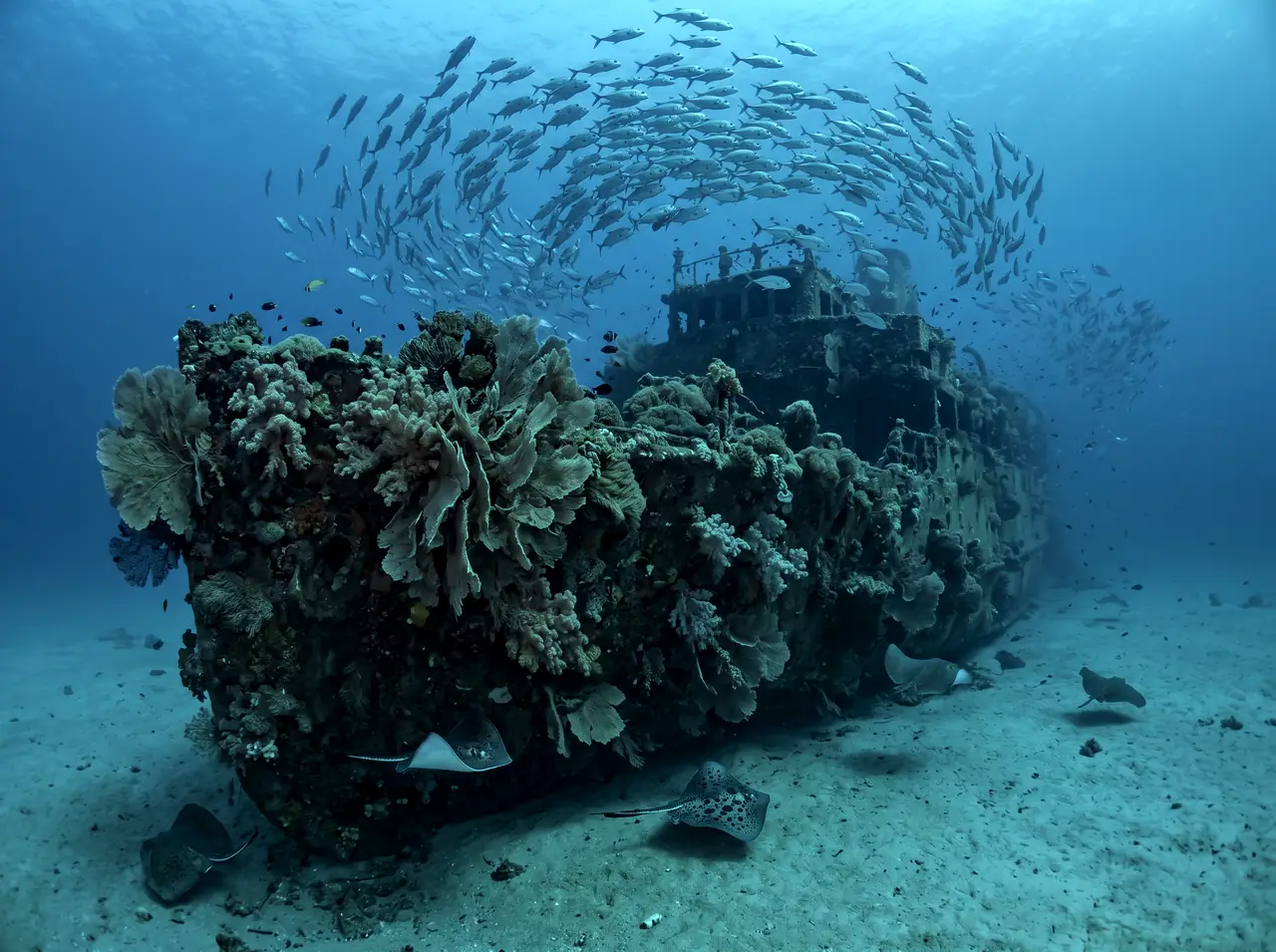
SS Yongala
Overview
The SS Yongala is consistently ranked among the world's greatest wreck dives, not for its historical significance alone, but for the extraordinary marine life that inhabits and visits this isolated underwater structure. This 110-meter steel passenger ship sank in a cyclone in March 1911 off the coast of Townsville, Queensland, with the loss of all 122 people aboard. The wreck lies on its starboard side on a sandy seabed at 15–30 meters in open ocean, making it the only significant structure in a vast expanse of featureless sand. This isolation transforms the Yongala into a marine life magnet of unparalleled intensity. Bull sharks are regularly encountered, cruising past the hull with calm authority. Giant Queensland groupers — some exceeding 2 meters in length — lumber along the wreck. Olive sea snakes, numerous and curious, swim directly toward divers' masks. Manta rays and eagle rays visit the wreck during the cooler months, and massive marble rays rest on the sand nearby. Green sea turtles are abundant, and barracuda and trevally schools hang in the blue above the wreck. The hull itself is encrusted in hard and soft corals, sponges, and anemones, supporting a mini ecosystem. Penetration is prohibited as the wreck is a protected gravesite. The SS Yongala is accessed by day boat from Alva Beach or Townsville, Queensland, approximately 90 minutes offshore. Conditions can be challenging — strong currents, limited visibility (sometimes below 10 meters), and open-ocean exposure require experience. When conditions align, the Yongala delivers what many divers consider the single best dive of their lives.
Early access
Plan a dive here
Open the DiveOne planner to sketch a recreational plan before you go. It is a planning assistant, not a dive computer.
Marine life
Dive profile
DEPTH PROFILE
DEPTH PROGRESSION & WAYPOINTS: SS Yongala
Location
Frequently asked questions
What certification is needed for the SS Yongala?
Advanced Open Water certification is the minimum, and many operators require it with a minimum of 30 logged dives. The wreck sits at 15–30 meters with frequently strong currents and limited visibility. Open-water experience is essential.
When is the best time to dive the Yongala?
June to November offers the best conditions, with the dry season bringing calmer seas, better visibility (10–25 meters), and resident manta rays. The wreck is diveable year-round, but cyclone season (December–April) can prevent access.
Why is the SS Yongala considered one of the best wreck dives in the world?
The Yongala is an isolated artificial reef in open ocean — the only structure for miles, which concentrates an extraordinary density and diversity of marine life. Bull sharks, giant groupers, sea snakes, manta rays, and turtles are regular visitors, making it more about marine life than wreck exploration.
Reviews
Reviews
No reviews yet
Data Provenance
This profile is compiled from 3 operator submissions and 142 community logs. Key facts (depth, entry) are verified against official hydrographic charts.