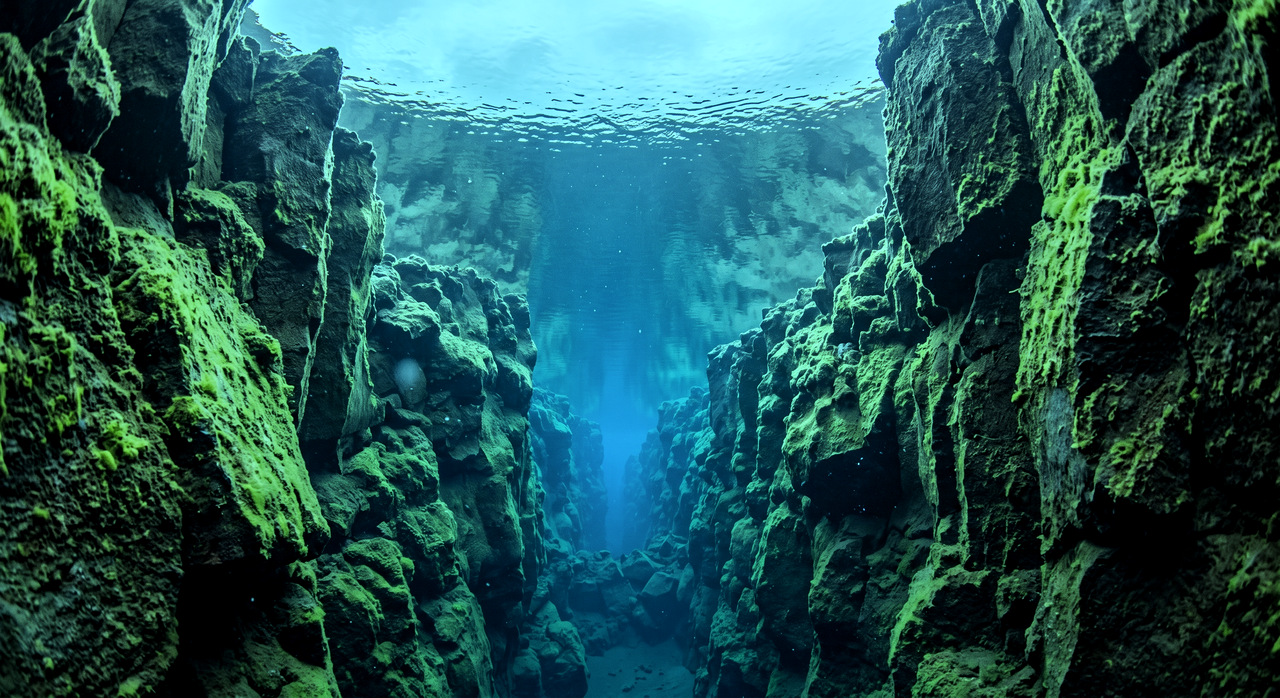
Silfra Fissure
Overview
There is no other dive on Earth quite like Silfra. Set within Thingvellir National Park — a UNESCO World Heritage Site and the birthplace of Iceland's ancient parliament — this tectonic fissure lies at the exact boundary where the Eurasian and North American continental plates are slowly pulling apart at roughly two centimetres per year. The crack they leave behind fills with glacial meltwater that has been filtered through volcanic lava rock for anywhere from 30 to 100 years, emerging in Silfra with a purity and clarity that simply has to be experienced to be believed. Visibility at Silfra routinely exceeds 100 metres. I need to write that again because numbers that extreme tend to lose their meaning: you can see clearly for more than the length of a football pitch. The water is so transparent that it initially feels like hovering in mid-air above the rocky fissure floor, with nothing but a gentle current and the faint ripple of the surface above to remind you that you are submerged. The effect is simultaneously serene and vertigo-inducing. The dive follows a natural route through four distinct sections. Silfra Big Crack is a narrow canyon with walls close enough to swim between. Silfra Hall opens into a wider chamber where bright green algae, known locally as troll hair, sways from the rock in wispy strands. Silfra Cathedral is the deepest section at 18 metres, a vast underwater chamber where the blue water creates an almost cathedral-like sense of space and awe. Finally, Silfra Lagoon is a shallow, wide pool that serves as the exit point, its bottom carpeted in brilliant green algae that seems to glow in the filtered Icelandic light. The trade-off for this extraordinary clarity is temperature: Silfra holds steady at 2 to 4 degrees Celsius year-round. A drysuit is not optional — it is essential, and operators require documented drysuit experience or certification. Despite the cold, most divers describe the experience as comfortable enough once properly insulated, though hands and face feel the chill acutely. Silfra is diveable year-round, with winter offering the bonus of the northern lights on the drive back to Reykjavik. This is a dive site that belongs on every serious diver's lifetime list, not for the marine life — which is minimal — but for a sensory experience that exists nowhere else.
Early access
Plan a dive here
Open the DiveOne planner to sketch a recreational plan before you go. It is a planning assistant, not a dive computer.
Marine life
Dive profile
DEPTH PROFILE
DEPTH PROGRESSION & WAYPOINTS: Silfra Fissure
Location
Near Reykjavik, in the Thingvellir National Park region of Iceland.
Frequently asked questions
Do I need drysuit certification to dive Silfra?
Yes, drysuit certification or documented proof of drysuit experience is mandatory for diving Silfra. All dive operators enforce this requirement without exception. The water temperature is a constant 2 to 4 degrees Celsius year-round, making a drysuit essential for safety. If you do not have drysuit experience, several operators offer drysuit courses in Reykjavik that can be completed before your Silfra dive, or you can participate as a snorkeller, which requires no special certification.
Why is the water at Silfra so incredibly clear?
Silfra's extraordinary visibility is the result of a natural filtration process that takes 30 to 100 years. Glacial meltwater from Langjökull glacier percolates through porous volcanic lava rock for decades, during which virtually all sediment and particles are removed. By the time the water emerges in the Silfra fissure, it is among the purest on Earth. The constant 2 to 4 degree temperature year-round and minimal organic matter in the water ensure the clarity is maintained permanently.
Can I touch the walls of both tectonic plates during the dive?
In the narrowest section of Silfra, known as Silfra Hall, it is physically possible to extend your arms and touch the Eurasian plate on one side and the North American plate on the other. However, touching the rock walls is discouraged and in some areas prohibited, as it can disturb the delicate algae growth and degrade the experience for other divers. Operators emphasise a hands-off approach to preserve the fissure's pristine condition.
Reviews
Reviews
No reviews yet
Data Provenance
This profile is compiled from 3 operator submissions and 142 community logs. Key facts (depth, entry) are verified against official hydrographic charts.