Seogwipo Submarine Volcano
Overview
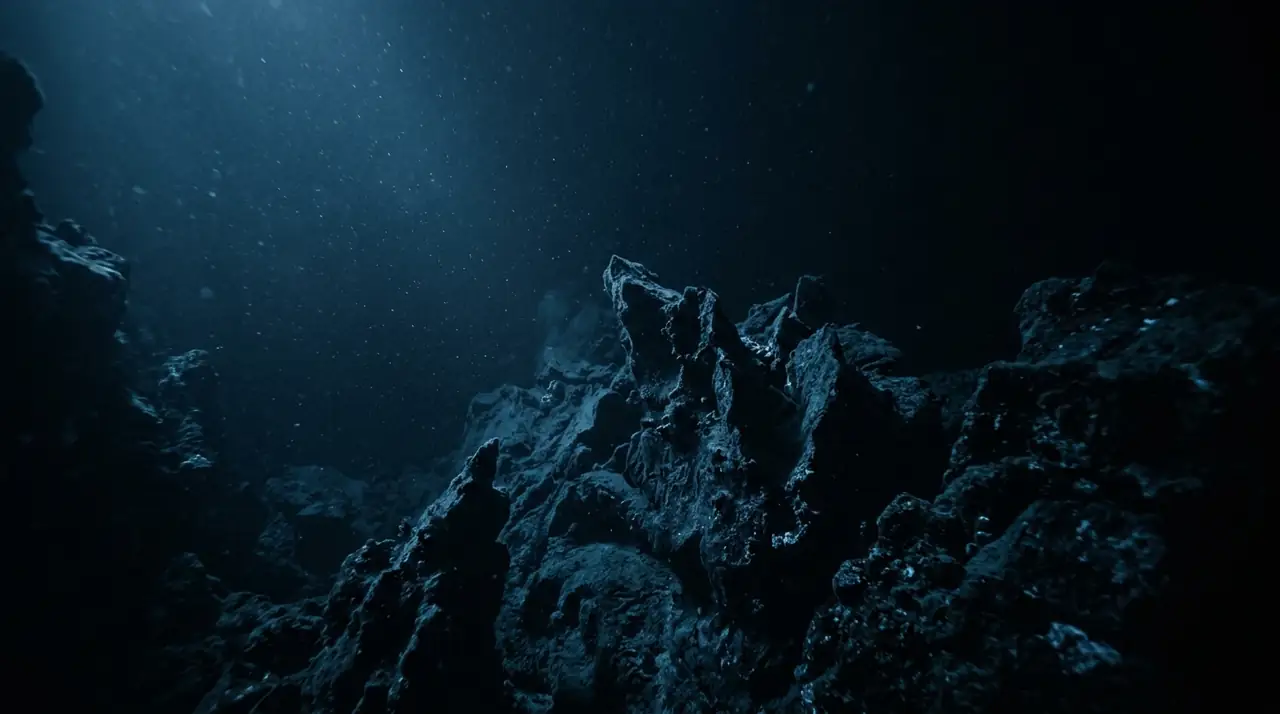
The Seogwipo Submarine Volcano is a submerged volcanic cone off the southern coast of Jeju Island, South Korea's subtropical gem in the Korea Strait. The cone rises from roughly 70 metres to within 15 metres of the surface, its flanks composed of hexagonal basalt columns colonised by an extraordinary mix of temperate and subtropical marine life. The warm Tsushima Current from the south meets colder water from the Yellow Sea here, creating a biological melting pot. I descended the mooring line into water that turned progressively cooler and darker. At 20 metres the cone materialised as a wall of dark basalt columns, their geometric edges softened by decades of encrusting growth. Bright orange and yellow soft corals clung to every surface, polyps extended into the current to feed. Between the columns, thick kelp fronds rose vertically like a forest canopy, filtering light into green-gold shafts. A school of several hundred striped beakfish spiralled around the cone's upper section, their black-and-white bodies creating a dizzying vortex. Yellowtail jacks cut through at speed, picking off stragglers. On the rock face, nudibranchs in vivid reds and blues moved slowly across sponge patches, while sea urchins and starfish covered the lower surfaces in spiny carpets. An octopus watched me from a crevice between two basalt pillars, its skin shifting to match the dark rock. Deeper along the cone, lava tubes opened into small caverns where rockfish hovered in the shadows and soft coral gardens reached peak density. The basalt columns here stood in rows like organ pipes in a submerged cathedral. Sea bream gathered in the lee of the structure, sheltering from the current. Ascending along the volcanic wall, the water warmed noticeably and the kelp thickened, until I emerged into sunlit shallows where the cone's flat top was carpeted in sea grass and juvenile fish. The Seogwipo Submarine Volcano reminded me that some of Asia's most compelling diving lies not in the tropics but in temperate waters where two worlds collide.
Early access
Plan a dive here
Open the DiveOne planner to sketch a recreational plan before you go. It is a planning assistant, not a dive computer.
Marine life
Dive profile
DEPTH PROFILE
DEPTH PROGRESSION & WAYPOINTS: Seogwipo Submarine Volcano
Location
Frequently asked questions
How do I reach the Seogwipo Submarine Volcano dive site?
The dive site is located approximately 2 kilometres offshore from Seogwipo on Jeju Island's southern coast. Jeju is accessible by air from Seoul with multiple daily flights taking about an hour, or by ferry from Busan or Mokpo. Once on Jeju, Seogwipo is roughly 40 minutes by car from Jeju International Airport. Local dive operators based in Seogwipo harbour provide boat transfers to the volcano site.
What certification is required?
Advanced Open Water certification is required due to the depth, which reaches 40 metres at the base of the volcanic cone. Strong currents are common around the structure, and conditions can deteriorate rapidly. Most dive operators require at least 30 logged dives and may ask for proof of recent cold-water diving experience. Shallower sections of the cone between 15 and 25 metres can be accessed by intermediate divers in calm conditions.
What is the water temperature like?
Jeju's waters are temperate, ranging from 13 degrees Celsius in winter to 25 degrees in late summer. A drysuit or thick semi-dry wetsuit is recommended from November through April. During summer months a 5mm wetsuit is sufficient. Thermoclines are common around the volcanic cone, with temperature drops of 3 to 5 degrees possible during descent to the deeper sections.
Reviews
Reviews
No reviews yet
Data Provenance
This profile is compiled from 3 operator submissions and 142 community logs. Key facts (depth, entry) are verified against official hydrographic charts.