Ras Za'atar
Overview
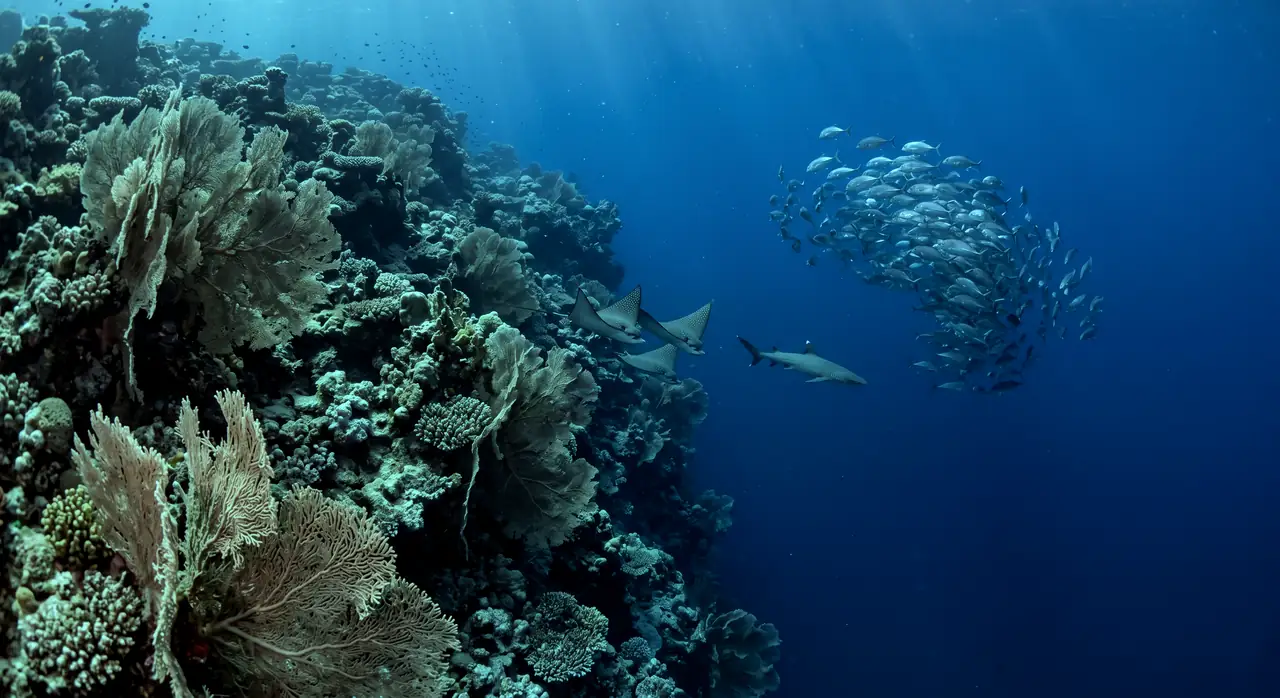
Ras Za'atar is one of those Hurghada-area reefs that rewards divers willing to handle a bit of current in exchange for genuine pelagic encounters. This promontory reef north of Hurghada juts into the prevailing current, creating an upwelling zone that attracts schooling fish and the predators that follow them. The northern wall is a showcase of Red Sea reef architecture at its most dramatic: dense gorgonian fans, whip corals, and soft corals decorating a vertical face that drops from a shallow reef flat to 30 metres and beyond. The boat anchored in the lee of the reef and we dropped in on the eastern side where current was manageable. Within moments of descending to 15 metres and rounding the corner to the exposed northern face, the current increased noticeably. This is where Ras Za'atar comes alive. The wall here is vertical and covered in large gorgonian fans oriented perpendicular to the current, their purple and gold branches creating a living tapestry. Drifting along the wall at 20 metres, I spotted the distinctive silhouette of a spotted eagle ray emerging from the blue. Then another. Then three more. Five eagle rays in loose formation cruised parallel to the wall, their spotted dorsal surfaces and long whip tails unmistakable. They passed within eight metres, seemingly unbothered by our presence, before banking away into the deeper blue. The wall attracts serious fish life. Schools of bluefin trevally hunted in coordinated packs along the edge. A napoleon wrasse of impressive size parked beside a coral overhang. In the blue beyond the wall, shapes of larger trevally and tuna moved at the edge of visibility. A whitetip reef shark rested on a sandy ledge at 28 metres, its gills pumping steadily. The shallower sections of the reef provide contrast. The reef flat between 5 and 10 metres hosts dense hard coral coverage, clouds of anthias, and the usual cast of Red Sea reef characters: lionfish under overhangs, groupers at cleaning stations, and moray eels threading through coral heads. Ras Za'atar is not a site for the faint-hearted or the unfit. The current demands attention and the temptation to follow the wall deeper is constant. But it delivers the kind of diving that the northern Red Sea sometimes struggles to match: genuine pelagic encounters within day-boat range of a major resort town.
Early access
Plan a dive here
Open the DiveOne planner to sketch a recreational plan before you go. It is a planning assistant, not a dive computer.
Marine life
Dive profile
DEPTH PROFILE
DEPTH PROGRESSION & WAYPOINTS: Ras Za'atar
Location
Frequently asked questions
How strong are the currents at Ras Za'atar?
Currents at Ras Za'atar are moderate to strong depending on tidal conditions and wind. The northern promontory acts as a point where current accelerates as it wraps around the reef. Drift diving is the standard technique, entering upcurrent and drifting along the wall to a sheltered pickup point. Most operators assess conditions before committing to the dive and may redirect to alternative sites if current exceeds safe levels. A surface marker buoy and experience with drift diving are required.
What certification level do I need for Ras Za'atar?
Most operators require Advanced Open Water certification and experience with current diving. The wall descends to 30 metres and strong currents can make depth control challenging for inexperienced divers. Comfort with negative entries from a moving boat, use of a surface marker buoy, and the ability to maintain neutral buoyancy in current are all essential. Some operators accept confident Open Water divers with drift diving experience on calmer days.
What is the best time of day to dive Ras Za'atar?
Early morning dives typically offer the best pelagic encounters at Ras Za'atar. Eagle rays are most commonly seen during the first dive of the day, often cruising along the wall edge between 15 and 25 metres. The current also tends to be more predictable in the morning before afternoon winds increase. Visibility is generally excellent regardless of time but peaks in the morning before boat traffic stirs up particulate matter in shallower areas.
Reviews
Reviews
No reviews yet
Data Provenance
This profile is compiled from 3 operator submissions and 142 community logs. Key facts (depth, entry) are verified against official hydrographic charts.