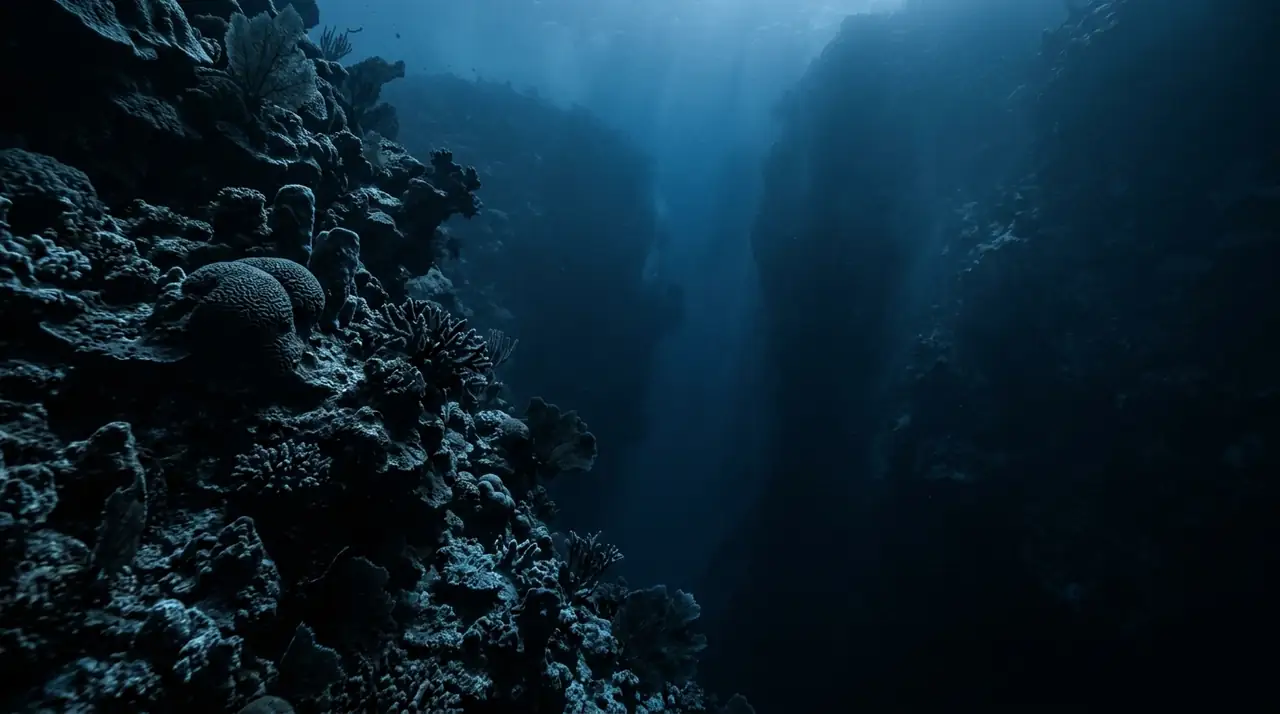
Pulau Ai South Wall
Overview
The South Wall of Pulau Ai drops from a shallow reef crest directly into the deep Banda Sea, a vertical face catching the full force of nutrient-rich currents sweeping across Indonesia's most historically significant island group. Where the northern shores offer gentle slopes, the south face is raw exposure — and that exposure creates wall diving of remarkable intensity. The descent begins at the reef edge around five metres, where healthy hard corals transition abruptly to vertical rock. Within seconds of dropping below the rim, the wall is carpeted in soft corals — dendronephthya in purple, orange, and pink clustered so densely they overlap, polyps extended and feeding. Gorgonian fans reach outward, some exceeding two metres in span, creating a layered vertical garden. At thirty metres the character shifts. Soft coral gives way to bare rock where the current accelerates, and this is where the pelagics patrol. Grey reef sharks are constant, cruising the wall edge in loose groups. On my dawn dive, descending to thirty-five metres in grey half-light, a school of scalloped hammerheads materialized from below — perhaps fifteen animals moving in their characteristic stacked formation before disappearing back into the blue. The Banda Sea reaches over six thousand metres in places, and the upwelling drives the productivity visible on the wall. Dogtooth tuna blast through schools of fusiliers, and giant trevally hunt the reef edge with explosive acceleration. Above, the reef crest hosts its own attractions. Bumphead parrotfish herds graze the coral in the shallows, their crunching audible underwater. Napoleon wrasse drift with supervisory calm. The contrast between peaceful shallows and dramatic wall creates a dive with natural progression. Reaching Pulau Ai requires effort — flights to Ambon, connection to Banda Neira, then boat transfer — but the Banda Islands reward that effort with diving that combines remoteness, historical significance, and underwater quality reflecting centuries of minimal human impact.
Early access
Plan a dive here
Open the DiveOne planner to sketch a recreational plan before you go. It is a planning assistant, not a dive computer.
Marine life
Dive profile
DEPTH PROFILE
DEPTH PROGRESSION & WAYPOINTS: Pulau Ai South Wall
Location
Frequently asked questions
How is the South Wall different from other Pulau Ai dive sites?
The South Wall is the most exposed face of Pulau Ai, catching the full force of Banda Sea currents flowing from the south. This exposure delivers higher nutrient loads that feed exceptional soft coral density on the vertical face, and the deeper sections attract pelagic species more reliably than the protected northern sites. However, this exposure also means stronger currents and less predictable conditions, making it suited to experienced divers comfortable with negative entries and drift techniques.
When is the best time to see hammerheads at Pulau Ai?
Hammerhead sharks are most reliably encountered at the South Wall during September through November when cooler, nutrient-rich upwellings occur along the wall face. Early morning dives before 7 AM offer the highest probability as the sharks patrol the deeper sections of the wall between 30 and 45 metres during low-light conditions. Schools typically number between 5 and 20 individuals, though larger aggregations have been reported.
Can I reach Pulau Ai without a liveaboard?
Yes, Pulau Ai can be reached from Banda Neira by local boat in approximately 90 minutes. Banda Neira itself connects to Ambon by twice-weekly flights or overnight ferry. A small number of homestays exist on Pulau Ai, and dive operations from Banda Neira organise day trips. However, liveaboards provide more flexibility and can time dives for optimal current and light conditions at the South Wall, which requires early morning access for the best pelagic encounters.
Reviews
Reviews
No reviews yet
Data Provenance
This profile is compiled from 3 operator submissions and 142 community logs. Key facts (depth, entry) are verified against official hydrographic charts.