Oga Maru Wreck
Overview
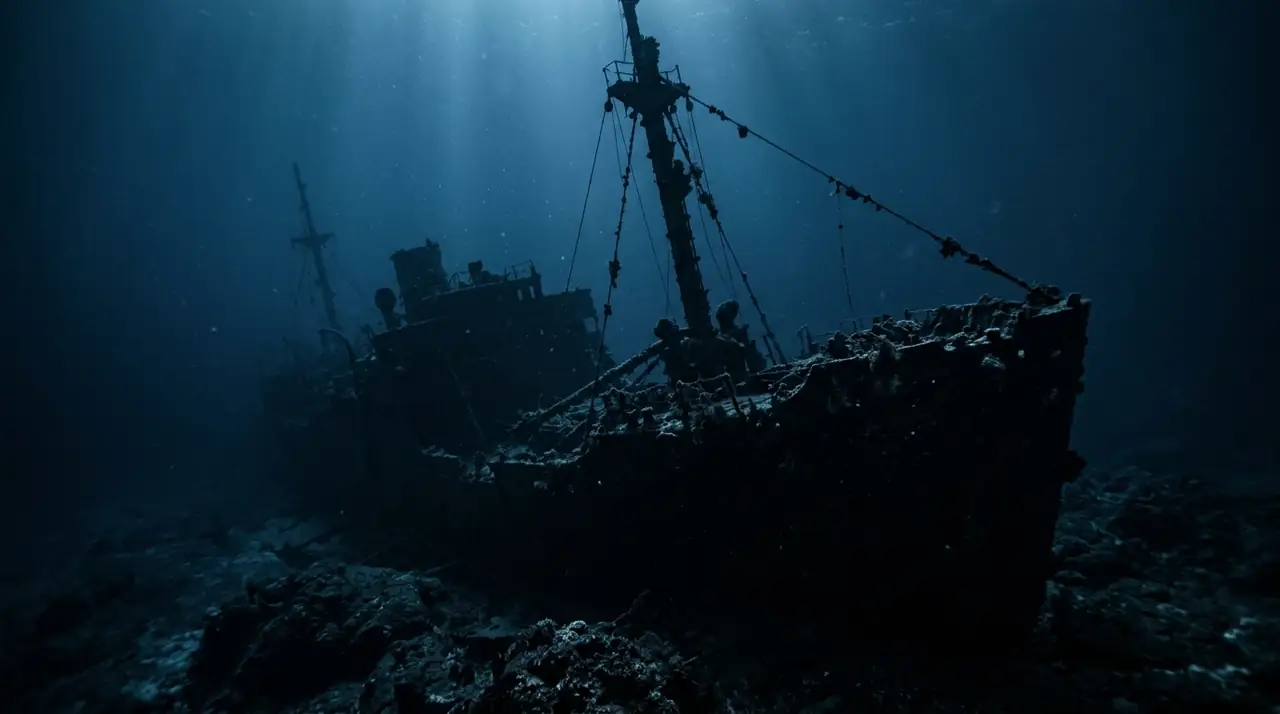
The Oga Maru sits upright on the sandy bottom of the Persian Gulf off Kuwait, a Japanese cargo freighter turned artificial reef that has become one of the country's most popular dive sites. In waters where the flat seabed offers little natural structure, wrecks like this become magnets for marine life, concentrating fish populations and creating ecosystems that would not otherwise exist. I descended through green-tinged water with visibility around 6 meters, and the wreck materialised with dramatic suddenness -- one moment hazy water, the next, the dark mass of the superstructure looming from the murk. The Oga Maru rests with a slight list but is largely intact, masts still reaching upward, bridge accessible through open hatches, cargo holds dark and cavernous. Swimming along the deck, every surface was colonised by barnacles, hydroids, and encrusting organisms. Hammour groupers lurked in every doorway and hatch opening, their mottled bodies barely distinguishable from rusted metal. Orange-spotted groupers held station beneath overhangs, and lionfish fanned their venomous spines in sheltered corners of the bridge. Penetrating the cargo holds required a good torch and careful buoyancy, as the silty interior reduces visibility rapidly with careless fin kicks. Inside, torches revealed schools of batfish hovering in the gloom, snappers retreating into darker recesses, and sea snakes threading through structural gaps with disconcerting speed. The engine room offered the most atmospheric section -- gauges still visible on control panels, machinery draped in marine growth. Surfacing, Kuwait City's skyline shimmered in the Gulf haze, a reminder of the contrast between the desert nation's modern surface and the hidden underwater world offshore. The Oga Maru may not offer crystal visibility or tropical coral, but it delivers genuine wreck diving atmosphere and the satisfaction of exploring a site few international divers know exists.
Early access
Plan a dive here
Open the DiveOne planner to sketch a recreational plan before you go. It is a planning assistant, not a dive computer.
Marine life
Dive profile
DEPTH PROFILE
DEPTH PROGRESSION & WAYPOINTS: Oga Maru Wreck
Location
Frequently asked questions
What type of ship is the Oga Maru?
The Oga Maru is a Japanese cargo freighter that sank in Kuwaiti waters and now rests upright on the sandy bottom at approximately 18 meters depth. The vessel is reasonably well-preserved with intact bridge, engine room, and cargo holds accessible for penetration diving. The ship has become an effective artificial reef, attracting significant marine life populations to an otherwise featureless sandy seabed. Its relatively shallow depth and upright position make it one of the most accessible wreck dives in the Arabian Gulf.
What is visibility like on the Oga Maru?
Visibility on the Oga Maru is the most challenging aspect of this dive. The Arabian Gulf's shallow, warm waters tend to support high plankton levels, and the sandy bottom around the wreck can reduce visibility further when disturbed by divers or currents. Typical visibility ranges from 3 to 10 meters, with best conditions during winter months when water temperatures are cooler and plankton levels lower. Good torch discipline and close communication with your buddy are essential. Despite the limited visibility, the wreck provides a compelling dive experience.
Is there a dive community in Kuwait?
Kuwait has a small but enthusiastic recreational diving community, with several dive centres operating from the city's coastline and marinas. The scene is growing, driven by interest from both expatriate and Kuwaiti divers. Dive operators offer trips to several wreck sites, reef patches, and artificial reef structures. The Kuwait Diving Team, a volunteer organisation, has been active in marine conservation and artificial reef deployment. Equipment is available for rent, but serious divers often bring their own gear due to limited sizing options.
Reviews
Reviews
No reviews yet
Data Provenance
This profile is compiled from 3 operator submissions and 142 community logs. Key facts (depth, entry) are verified against official hydrographic charts.