Nassau Blue Hole (Tongue of the Ocean)
Overview
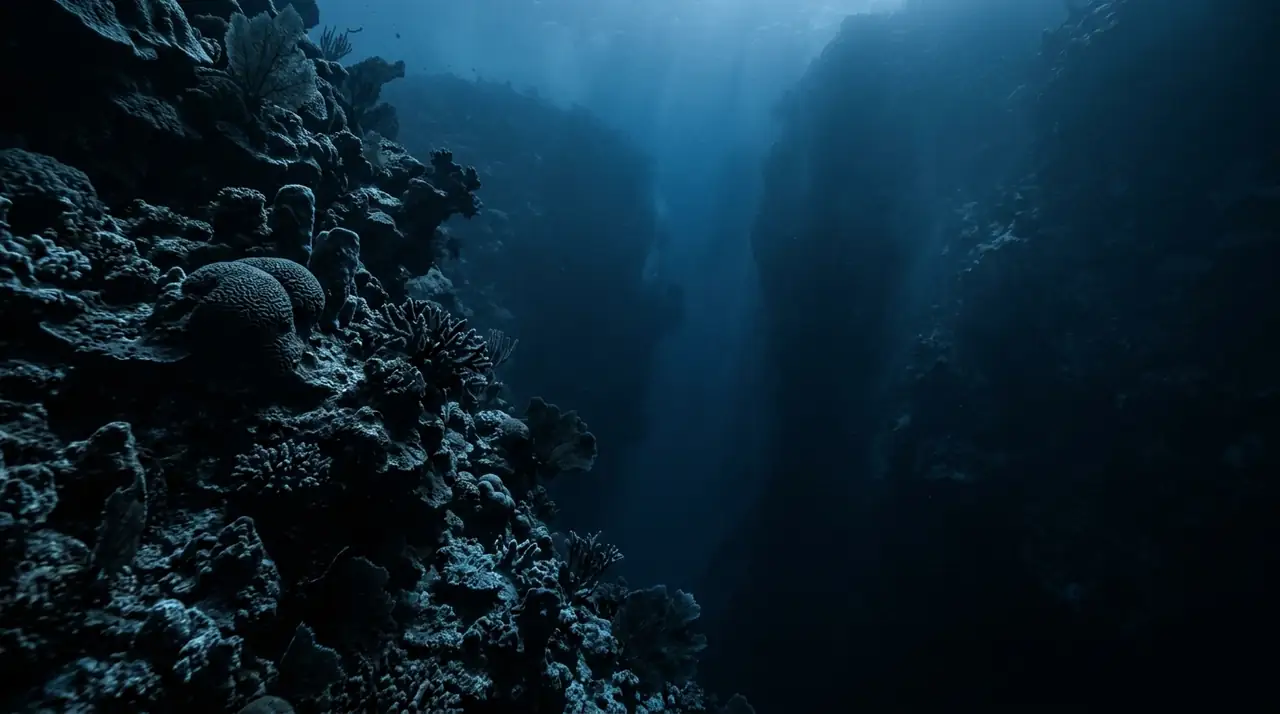
The Tongue of the Ocean is one of the Atlantic's most dramatic geological features, a deep trench slicing into the Great Bahama Bank, reaching depths exceeding 2,000 metres just miles from the shallow turquoise waters surrounding Nassau. At the edge of this abyss, blue holes and wall formations create experiences that rank among the most visually striking in the Caribbean. The boat ride from Nassau crosses the shallow bank in water so clear you can see the sand bottom throughout. Then, abruptly, the colour changes. Turquoise deepens to cobalt, then to the bottomless navy blue marking the trench edge. This transition never fails to provoke a visceral response, visual proof of an ocean floor falling away beneath your fins. I descended along the wall at the blue hole entrance, a curved amphitheatre where the shelf drops vertically into darkness. At 15 metres the wall is rich with sponges, sea fans, and gorgonians. Black coral bushes appear at greater depth, their delicate branches hosting tiny gobies and shrimp. Visibility exceeded 40 metres, and looking into the abyss the wall simply faded into blue without visible bottom. Caribbean reef sharks patrol the wall edge with purposeful efficiency. I counted four on a single dive, cruising in overlapping circuits along the drop-off. The lack of shark feeding operations here means encounters feel natural and unmanipulated. Nurse sharks rest on sandy ledges, and spotted eagle rays glide past with their distinctive undulating flight. The shelf top is a different world entirely. Shallow coral gardens support healthy populations of Nassau grouper, large green moray eels draped from coral heads, and schools of horse-eye jacks circling divers in silvery walls. Hawksbill turtles forage on sponges, and yellowtail snappers follow divers in hopeful clouds. What makes this diving compelling is the juxtaposition of the familiar and the profound. You begin on a classic Caribbean reef, cross a geological boundary, and look into one of the deepest features in the Atlantic. The abyss adds a psychological dimension that flat reef diving cannot replicate.
Early access
Plan a dive here
Open the DiveOne planner to sketch a recreational plan before you go. It is a planning assistant, not a dive computer.
Marine life
Dive profile
DEPTH PROFILE
DEPTH PROGRESSION & WAYPOINTS: Nassau Blue Hole (Tongue of the Ocean)
Location
Frequently asked questions
What is the Tongue of the Ocean and why is it significant for diving?
The Tongue of the Ocean is a deep oceanic trench that penetrates the Great Bahama Bank, reaching depths exceeding 2,000 metres. The trench creates a dramatic wall where the shallow Bahamian shelf drops vertically into deep blue water. This depth differential generates upwelling currents that bring nutrient-rich water to the surface, attracting pelagic species and supporting diverse reef life on the wall itself. The US Navy has used the trench for deep-water testing since the 1960s due to its depth and proximity to shore. For divers, the wall represents one of the most dramatic depth transitions accessible from Nassau.
How far is this site from Nassau and how do I get there?
The blue hole and wall sites on the Tongue of the Ocean edge are approximately 30 to 45 minutes by boat from Nassau harbour, depending on the specific site and sea conditions. Several Nassau-based dive operators run daily trips to the Tongue of the Ocean wall and nearby blue holes, typically as two-tank morning excursions. The boat ride crosses the shallow turquoise waters of the Bahama Bank before reaching the dramatic colour change where the shelf drops into the deep trench. Departures are usually around 8am with return by early afternoon.
Is this dive site suitable for Open Water certified divers?
The wall edge and blue hole sites are best suited to Advanced Open Water divers or those with equivalent experience, as the main attractions are at 20 to 40 metres and the vertical wall can be disorienting for less experienced divers. However, the shallow coral reef on the shelf top at 8 to 15 metres is excellent for Open Water certified divers and offers its own rich marine life. Many operators offer multi-level dive plans where experienced divers explore the wall while newer divers remain on the reef top under instructor supervision.
Reviews
Reviews
No reviews yet
Data Provenance
This profile is compiled from 3 operator submissions and 142 community logs. Key facts (depth, entry) are verified against official hydrographic charts.