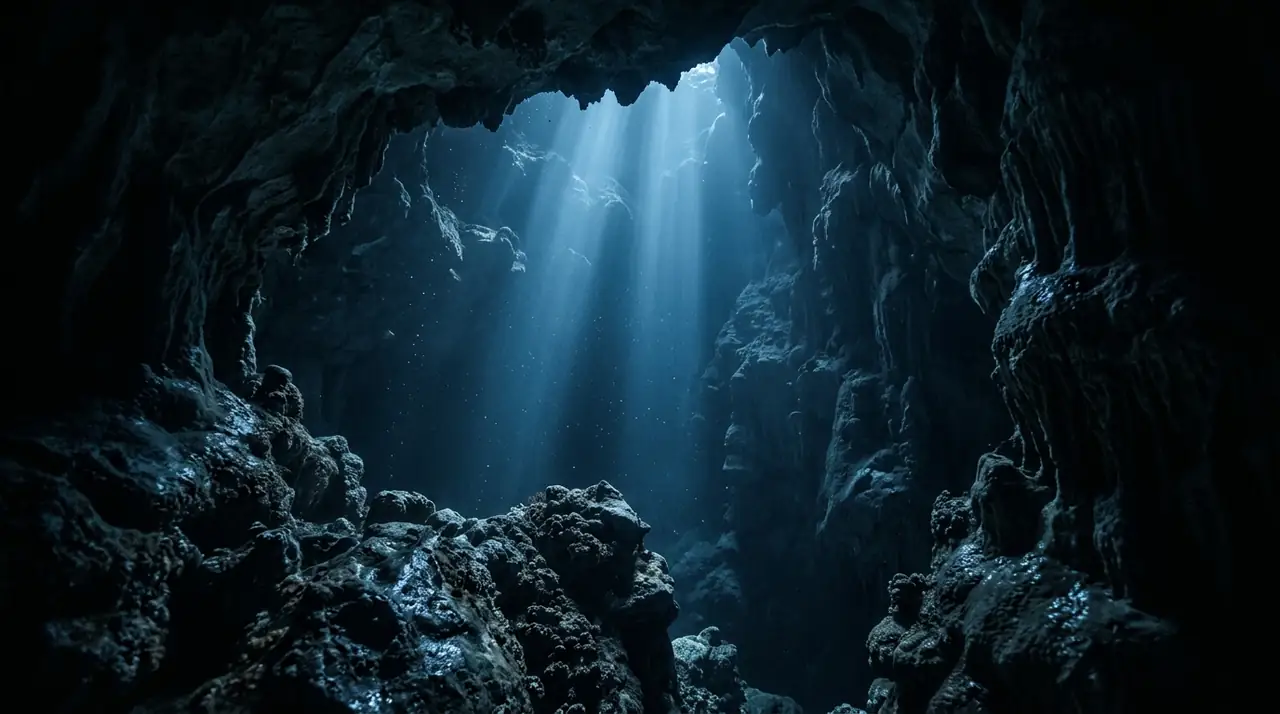
Motu Nui Cave
Overview
Easter Island, Rapa Nui, sits in the southeastern Pacific as the most isolated inhabited island on Earth, over three thousand five hundred kilometres from Chile and two thousand from the nearest populated neighbour. Its underwater landscape mirrors the volcanic drama above: lava flows, collapsed tubes, and cave systems extending beneath the ocean in formations shaped by ancient eruptions. The Motu Nui Cave system, near the sacred islet that once hosted the Birdman ceremony, represents the island's most spectacular underwater volcanic architecture. The boat ride from Hanga Roa follows the coastline south and west to Orongo, the clifftop village where the Tangata Manu ceremony determined political power through a perilous swim to Motu Nui for sooty tern eggs. The three islets of Motu Nui, Motu Iti, and Motu Kao Kao rise from the sea below sheer cliffs, and the underwater terrain is a continuation of the volcanic landscape above: tumbled basalt blocks, lava flow formations, and the dark openings of submerged lava tubes. Descending beside Motu Nui, the water clarity is astonishing. Easter Island regularly delivers visibility exceeding sixty metres, and the effect at a cave entrance is otherworldly: looking through the opening, the interior is illuminated by blue light of such purity that it appears artificially lit. The lava tubes vary in diameter from narrow swimthroughs requiring single-file passage to chambers wide enough for several divers, their walls coated in coralline algae and inhabited by spiny lobsters and soldierfish. The cave system extends through multiple connected chambers with natural skylights where collapsed ceiling sections allow shafts of sunlight to penetrate. These light wells create the site's most photographed moments, beams of light falling through blue water onto volcanic rock in compositions that feel composed rather than natural. Easter Island's extreme isolation has produced remarkable marine endemism. Approximately twenty-two percent of shore fish species are found nowhere else on the planet. The Easter Island butterflyfish, a striking endemic species, frequents the cave entrances and surrounding reef. The Rapanui moray, another endemic, occupies crevices in the volcanic rock. Every dive here carries the knowledge that you are observing species and ecosystems shaped by millions of years of oceanic isolation. The diving infrastructure on Rapa Nui consists of two or three operators based in Hanga Roa. Conditions at Motu Nui are weather-dependent, as the southwestern coast is exposed to Pacific swell, and boats must manage carefully in the lee of the islets. When conditions align, the combination of volcanic cave architecture, endemic marine life, and water clarity that defies belief creates one of the most unique dives on Earth. The Moai may draw visitors to Easter Island, but the caves beneath Motu Nui reveal a world equally worthy of the journey.
Early access
Plan a dive here
Open the DiveOne planner to sketch a recreational plan before you go. It is a planning assistant, not a dive computer.
Marine life
Dive profile
DEPTH PROFILE
DEPTH PROGRESSION & WAYPOINTS: Motu Nui Cave
Location
Near Hanga Roa, in the Rapa Nui (Easter Island) region of Chile.
Frequently asked questions
How does Motu Nui Cave differ from the Moai Underwater dive site?
The Moai Underwater site at Hanga Roa Bay is a shallow, relatively sheltered dive centred on a submerged Moai replica and volcanic slope at up to 22 metres. Motu Nui Cave is a cave diving experience on the exposed southwestern coast near the sacred islet of Motu Nui, involving penetration of volcanic lava tubes at depths to 25 metres. The two sites represent entirely different diving experiences: one is a gentle cultural dive accessible to intermediate divers, while Motu Nui Cave demands advanced certification, cave diving comfort, and careful boat management on an exposed coastline.
What is the cultural significance of Motu Nui?
Motu Nui is the largest of three islets off Easter Island's southwestern tip at Orongo, and it played a central role in the Tangata Manu or Birdman competition, one of Rapa Nui's most important cultural ceremonies. Each spring, competitors would swim the shark-infested channel to Motu Nui to retrieve the first egg of the sooty tern, and the winner's sponsor became the Birdman, holding great status for a year. The underwater caves near Motu Nui were part of this cultural landscape. Divers should approach the area with cultural sensitivity and follow all guidelines from Rapa Nui National Park.
What endemic marine species are found at Easter Island?
Easter Island's extreme isolation, over 3,500 kilometres from the South American mainland and 2,000 kilometres from the nearest inhabited island, has produced the highest rate of marine endemism in the Pacific. Approximately 22 percent of shore fish species are found nowhere else. The Easter Island butterflyfish, the Rapanui moray, and several species of wrasse and blenny are endemic. The marine environment is subtropical rather than tropical, with cooler water temperatures supporting a unique mix of tropical, subtropical, and temperate species alongside endemic forms. This biological uniqueness adds scientific significance to every dive.
Reviews
Reviews
No reviews yet
Data Provenance
This profile is compiled from 3 operator submissions and 142 community logs. Key facts (depth, entry) are verified against official hydrographic charts.