Marsa Egla
Overview
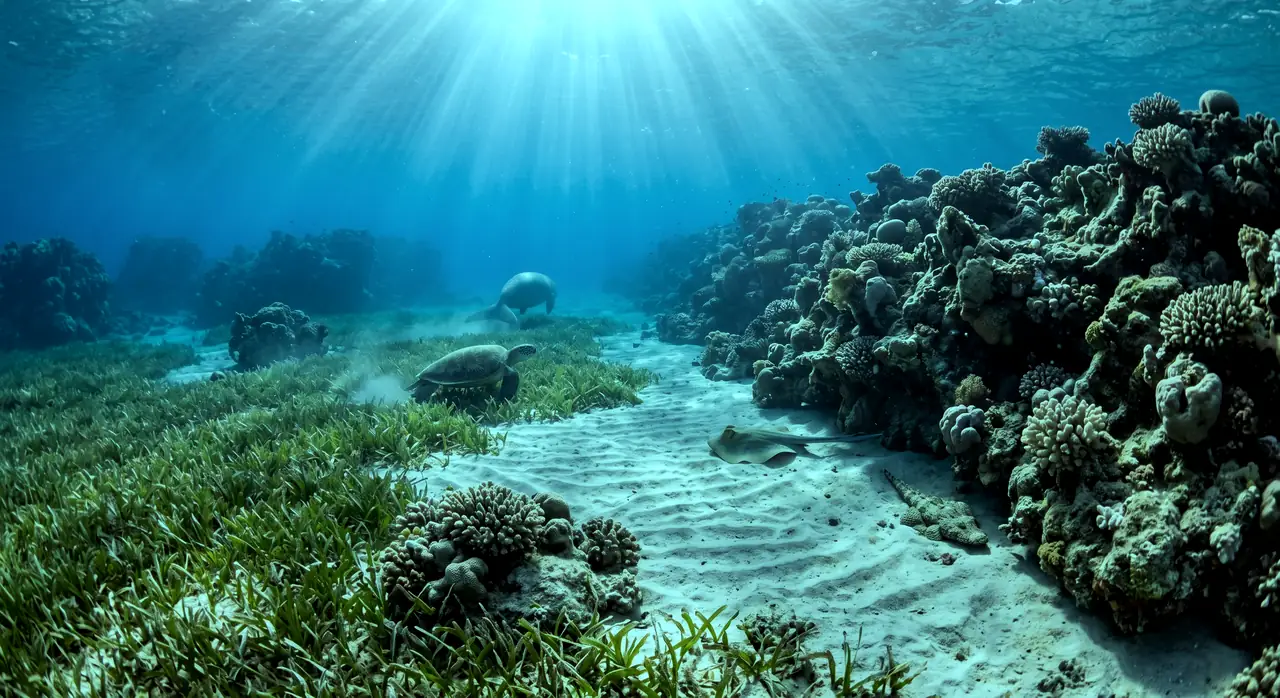
Marsa Egla is one of those Red Sea bays that tourism has somehow passed by. Located south of Marsa Alam on the Egyptian coast, this sheltered natural harbour combines extensive seagrass meadows with a healthy fringing reef in water rarely deeper than eighteen metres. The result is a marine environment of surprising richness, anchored by a resident population of green sea turtles and the tantalising possibility of dugong encounters, all accessible from a quiet beach with no resort infrastructure in sight. The bay opens to the east, protected from prevailing northerly winds by a low headland. The shallows are dominated by seagrass beds that extend from the shoreline to around five metres, their blades swaying gently in water so calm it feels like a swimming pool. Green sea turtles graze here with mechanical regularity, heads down in the grass, surfacing to breathe every few minutes with an explosive exhalation audible from the beach. On a typical morning, four or five turtles occupy the seagrass meadow simultaneously. Beyond the seagrass, a fringing reef develops along the bay's southern margin. The coral here is in notably good condition, with branching Acropora, fire coral, and brain coral creating a varied reef structure from six to eighteen metres. The fish life is typically Red Sea: clouds of anthias above every coral head, masked butterflyfish in mated pairs, crocodilefish lying immobile on sandy patches, and lionfish hovering under ledges. The dugong possibility adds a layer of anticipation to every dive. These shy marine mammals feed on the seagrass beds, and while encounters are infrequent compared to the more famous Abu Dabbab to the north, they do occur. I spent a surface interval scanning the bay and watched a dugong surface twice at the northern end, its round grey back breaking the surface briefly before disappearing. The following dive in that area produced no sighting, which is the nature of dugong diving: patience, luck, and the willingness to return.
Early access
Plan a dive here
Open the DiveOne planner to sketch a recreational plan before you go. It is a planning assistant, not a dive computer.
Marine life
Dive profile
DEPTH PROFILE
DEPTH PROGRESSION & WAYPOINTS: Marsa Egla
Location
Frequently asked questions
How likely are dugong sightings at Marsa Egla?
Dugong sightings at Marsa Egla are possible but not guaranteed. The bay's extensive seagrass beds provide feeding habitat for dugongs that range along the southern Egyptian Red Sea coast. Sightings occur most frequently during early morning dives when the bay is undisturbed, with estimates suggesting encounters on roughly one in five to one in ten visits. When a dugong is present, it typically feeds for extended periods, allowing patient divers to observe from a respectful distance. The nearby bay of Abu Dabbab offers somewhat more reliable dugong encounters, but Marsa Egla's sightings happen in a quieter, less commercial setting.
Is Marsa Egla suitable for new divers and snorkellers?
Marsa Egla is ideal for new divers and snorkellers. The bay is naturally sheltered from prevailing winds, creating calm flat water on most days. Maximum depth in the main diving area is around 18 metres, with the most productive zones between 3 and 10 metres. Shore entry is straightforward over a sandy beach. No currents are present inside the bay. Sea turtles frequent the shallows between 2 and 5 metres, making them accessible even to snorkellers. Many Marsa Alam dive centres use Marsa Egla for training dives and introductory experiences.
How does Marsa Egla compare to Abu Dabbab for turtle diving?
Both sites offer excellent turtle encounters, but the experience differs. Abu Dabbab is more developed with a resort beachfront, parking facilities, and higher visitor numbers. Marsa Egla remains less commercialised, with a more natural setting and fewer divers in the water. The turtle populations at both sites are comparable in density, though Abu Dabbab's are more habituated to divers. Marsa Egla compensates with better coral health on its fringing reef and a quieter atmosphere that many experienced divers prefer. For dugong seekers, Abu Dabbab has a slight statistical edge, but Marsa Egla's sightings tend to be more intimate.
Reviews
Reviews
No reviews yet
Data Provenance
This profile is compiled from 3 operator submissions and 142 community logs. Key facts (depth, entry) are verified against official hydrographic charts.