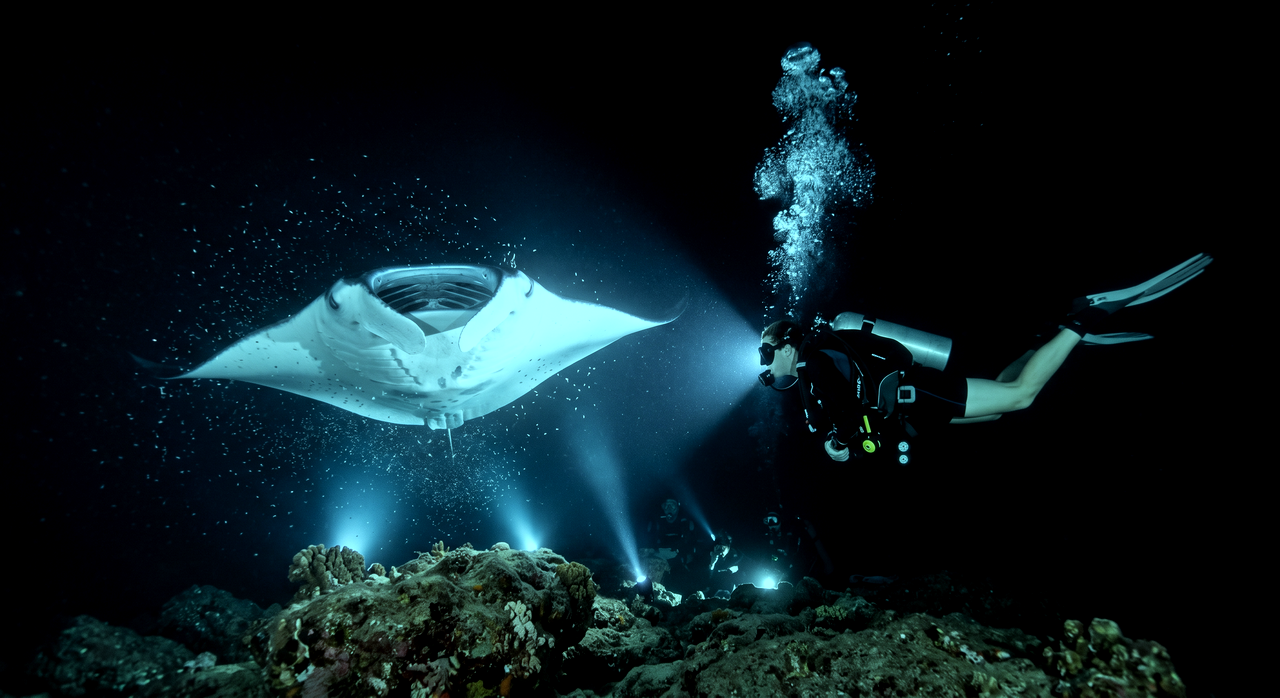
Manta Ray Night Dive (Garden Eel Cove)
Overview
The Manta Ray Night Dive at Garden Eel Cove off the Kona Coast of Hawaii's Big Island is widely considered the most magical night dive in the world. What began as an accidental discovery decades ago when lights from a nearby hotel attracted plankton and then mantas has evolved into a carefully managed wildlife encounter that ranks among diving's most unforgettable experiences. As darkness falls over the Kona Coast, dive boats motor out to a site just north of Keahole Point near the airport. Divers descend to a sandy patch at approximately 10-12 metres depth, arrange themselves in a circle, and point their dive lights upward. The beams concentrate plankton in the water column above, creating an irresistible feeding station for the area's resident manta rays. Within minutes, the first shadows appear overhead, and then the mantas arrive. Nearly 200 individually identified reef manta rays use this feeding ground, and on a good night, six to twelve animals may be performing simultaneously. They swoop through the light beams with mouths agape, filtering plankton in elegant barrel rolls and backward somersaults that bring their two-to-four-metre wingspans within centimetres of awestruck divers. The mantas are completely wild and free to leave at any time, yet they return night after night because the concentrated plankton provides easy feeding. The intimacy of watching a manta's cephalic fins unfurl and its mouth engulf a cloud of plankton directly above your head is a sensation that stays with divers for a lifetime. What makes this experience particularly special is its accessibility. At just 10-12 metres depth with no current on a calm sandy bottom, Open Water certification is all that is needed. Even non-divers can participate as snorkelers on the surface, floating above the light circle and watching the mantas feed below. The water temperature of 24-27 degrees Celsius is comfortable in a standard 3mm wetsuit. Operators run the dive year-round, though summer months tend to see the largest concentrations of plankton and mantas. Booking in advance is recommended, as this bucket-list experience draws visitors from around the globe.
Early access
Plan a dive here
Open the DiveOne planner to sketch a recreational plan before you go. It is a planning assistant, not a dive computer.
Marine life
Dive profile
DEPTH PROFILE
DEPTH PROGRESSION & WAYPOINTS: Manta Ray Night Dive (Garden Eel Cove)
Location
Frequently asked questions
How close do the manta rays get during the Kona night dive?
The mantas regularly pass within inches of divers, and gentle wing-tip contact does occur naturally. Divers sit on the sandy bottom at about 10-12 metres depth in a circle, pointing their dive lights upward to attract plankton. The mantas swoop in to feed, performing dramatic barrel rolls and somersaults directly in the light beams. The animals are completely wild and unrestrained, making the intimacy of the encounters extraordinary.
Do I need to be an experienced diver for the Kona manta night dive?
No, this is one of the most beginner-friendly bucket-list dives in the world. The depth is only about 10-12 metres, there are no currents, and divers simply kneel on a sandy bottom and hold their lights up. Open Water certification is sufficient, and many operators offer Discover Scuba options for non-certified individuals. Snorkelers can also participate by floating on the surface with lights pointing down.
Are manta ray sightings guaranteed on the Kona night dive?
While no wildlife encounter can be truly guaranteed, the Kona manta night dive has an exceptionally high success rate, with mantas appearing on approximately 90 percent of dives. Nearly 200 individual mantas have been identified visiting the site. The mantas are attracted by the concentrated plankton that gathers in the dive lights, so their presence is driven by reliable feeding behaviour rather than chance migration patterns.
Reviews
Reviews
No reviews yet
Data Provenance
This profile is compiled from 3 operator submissions and 142 community logs. Key facts (depth, entry) are verified against official hydrographic charts.