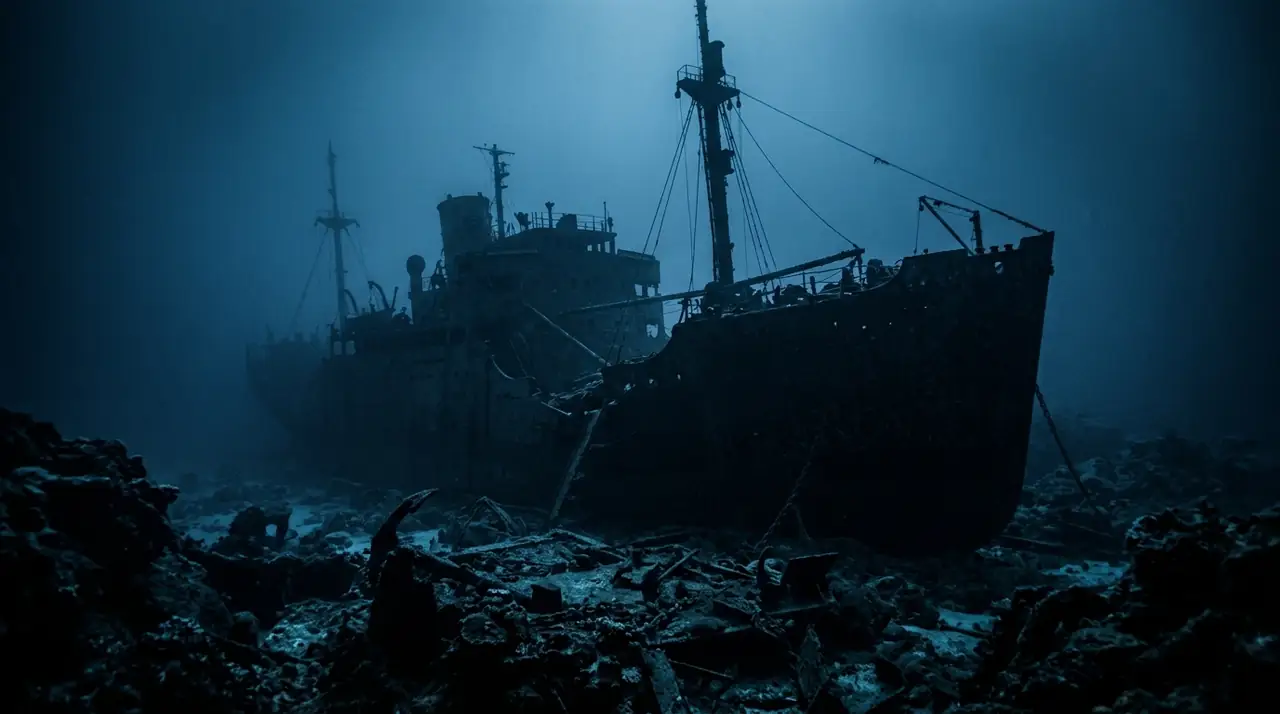
Kiritimati (Christmas Island) London Wreck
Overview
Kiritimati, known to English speakers as Christmas Island, is the world's largest coral atoll by land area, a vast ring of reef and lagoon in the Line Islands chain of Kiribati, straddling the equator roughly two thousand kilometres south of Hawaii. Its reefs are among the least explored in the Pacific, its waters teem with life that has never learned to fear humans, and its history spans Polynesian navigation, colonial exploitation, and nuclear testing. The London Wreck sits on the reef flat near the settlement of London. A World War II era landing craft, it rests upright in about fifteen metres of water, its steel hull colonised by corals that have transformed the vessel into a thriving artificial reef. Schools of snapper and surgeonfish swirl around the structure, grey reef sharks cruise the surrounding sand flats, and the wreck's interior shelters moray eels and coral groupers. But the London Wreck is really a starting point for understanding Kiritimati's diving potential. The atoll's outer reef stretches for hundreds of kilometres, the vast majority never dived. Where exploration has occurred, the findings have been remarkable: walls dropping from reef crest to oceanic depth with coral coverage rivalling Micronesia's best-preserved systems. Grey reef sharks are omnipresent, giant trevally hunt in packs, and manta rays cruise the channels between reef sections. The lagoon is famous for its bonefish flats, and underwater the shallow sand and seagrass environments support rays, juvenile sharks, and green sea turtles. Spinner dolphins frequent the lagoon entrance channels, their acrobatic displays a regular feature of surface intervals. Kiritimati's nuclear testing history adds a surreal layer. British and American atmospheric tests in the late 1950s and early 1960s left remnant military infrastructure slowly being reclaimed by vegetation. Underwater, the reefs bear no visible scars, having fully recovered in six decades. The contrast between destructive history and vibrant present speaks to the resilience of coral ecosystems given time and freedom from pressure. Logistics are the primary challenge. Flights are infrequent, accommodation basic, and dive infrastructure minimal. But for the self-sufficient diver, Kiritimati offers something increasingly rare: genuinely unexplored reef at the edge of the world.
Early access
Plan a dive here
Open the DiveOne planner to sketch a recreational plan before you go. It is a planning assistant, not a dive computer.
Marine life
Dive profile
DEPTH PROFILE
DEPTH PROGRESSION & WAYPOINTS: Kiritimati (Christmas Island) London Wreck
Location
Frequently asked questions
How do I get to Kiritimati (Christmas Island)?
Kiritimati is served by Fiji Airways flights from Nadi, operating weekly, and occasional charter flights from Honolulu. The flight from Fiji takes approximately three hours. The island has basic tourist accommodation including fishing lodges that can arrange dive trips. Kiritimati sits just north of the equator in the Line Islands chain, roughly halfway between Hawaii and Fiji. Note that Kiritimati in Kiribati is different from Christmas Island in the Indian Ocean, which is an Australian territory.
Is there an established dive operation on Kiritimati?
Kiritimati's diving infrastructure is minimal compared to mainstream dive destinations. Several fishing lodges offer diving as a secondary activity, and occasional expedition operators include Kiritimati on Pacific itineraries. Divers should expect to arrange equipment in advance and may need to bring critical items. The lack of established operations means flexibility and self-sufficiency are important. However, the diving potential is extraordinary, with hundreds of kilometres of unexplored outer reef and multiple wreck sites from the World War II and nuclear testing era.
What is the connection between Kiritimati and nuclear testing?
Kiritimati was used by both the United Kingdom and the United States for nuclear weapons testing in the 1950s and 1960s. The British conducted Operation Grapple hydrogen bomb tests in 1957 and 1958, while the US conducted Operation Dominic in 1962. The tests were atmospheric and did not directly damage the reef structure, though the social and health impacts on the local population remain controversial. Today, the nuclear testing legacy is primarily historical, and the reefs have recovered fully. Some remnant military infrastructure from the testing era can be found on the island and underwater.
Reviews
Reviews
No reviews yet
Data Provenance
This profile is compiled from 3 operator submissions and 142 community logs. Key facts (depth, entry) are verified against official hydrographic charts.