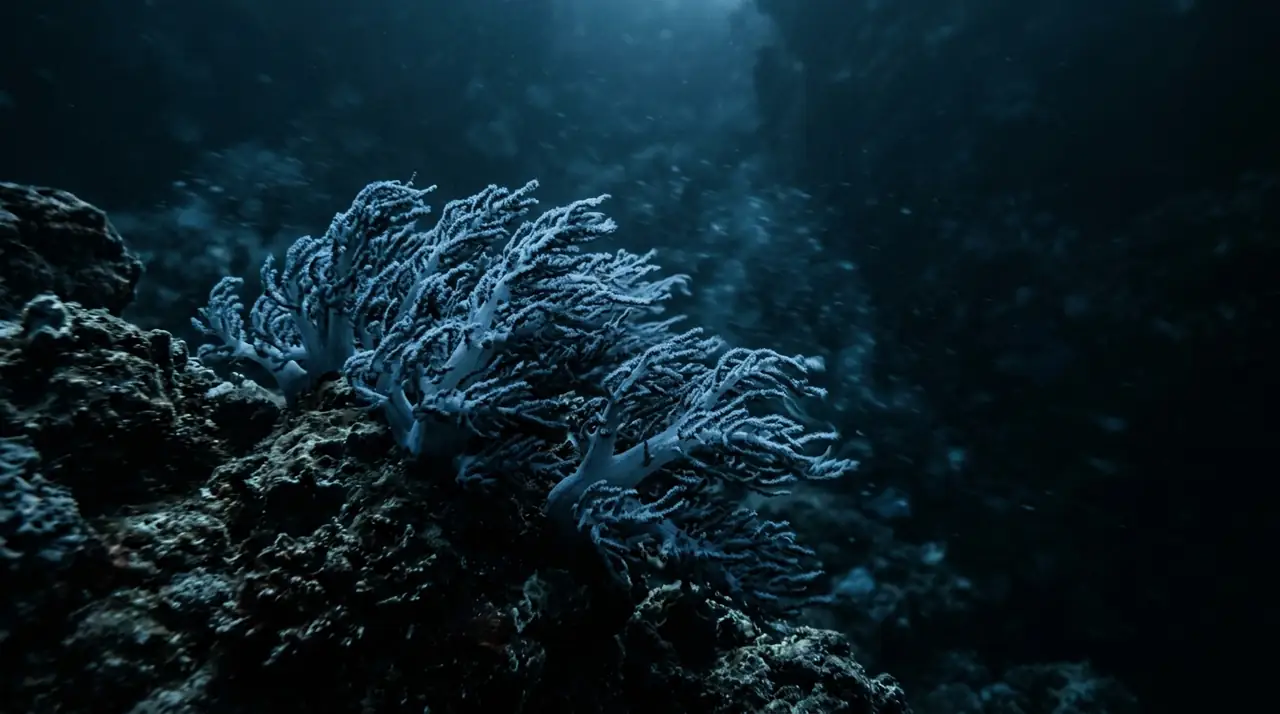
Isla Guadalupe Great White Sharks
Overview
Isla Guadalupe rises from the deep Pacific two hundred and forty kilometers west of Baja California, a volcanic outpost surrounded by some of the clearest open-ocean water on Earth. The island has become the world's premier destination for great white shark encounters, not because the sharks are more numerous here than elsewhere, but because the visibility is so extraordinary that encounters feel less like fleeting glimpses through murk and more like watching a nature documentary from inside the screen. The overnight crossing from Ensenada was rough, the Pacific swell building as we left the shelter of the Baja coast. By dawn, the island appeared as a dark volcanic silhouette against the morning sky, its barren slopes home to Guadalupe fur seals and northern elephant seals -- the prey base that draws great whites here every autumn. We anchored on the island's eastern side and the crew began deploying cages before breakfast. The first shark appeared within twenty minutes of entering the surface cage, a four-meter female that materialized from the deep blue at the edge of visibility, perhaps thirty meters away. She approached slowly, her conical snout and dark eyes growing more defined with each meter of distance closed. The clarity of the water was almost disorienting -- this animal was approaching in open water with nothing but blue in every direction, yet every detail was sharp: the grey-and-white countershading, the crescent tail sweeping in slow arcs, the gill slits fanning with each breath. Over the next three days, we encountered at least a dozen individual great whites, several of them well-known to researchers by their fin markings and scarring patterns. The submersible cage experience at twelve meters depth was transformative. Sitting on the ocean floor in a cage while a five-meter great white cruised past at eye level, with thirty-five meters of visibility revealing the full context of its world, redefined my understanding of these animals. They are not the frenzied attackers of cinema but measured, calculating predators whose every movement speaks of evolutionary perfection refined over millions of years.
Early access
Plan a dive here
Open the DiveOne planner to sketch a recreational plan before you go. It is a planning assistant, not a dive computer.
Marine life
Dive profile
DEPTH PROFILE
DEPTH PROGRESSION & WAYPOINTS: Isla Guadalupe Great White Sharks
Location
Frequently asked questions
Do I need to be a certified diver to do cage diving at Isla Guadalupe?
Surface cage diving does not require any dive certification. You breathe from a hookah system with air supplied from the surface, and the cage sits at the surface with a portion submerged. Submersible cage experiences, where the cage is lowered to 10 to 15 meters depth, do require scuba certification as participants use standard scuba equipment inside the cage. Both experiences are available on most liveaboard trips.
How do I get to Isla Guadalupe?
Isla Guadalupe is exclusively reached by liveaboard boats departing from Ensenada in Baja California, Mexico. The crossing takes approximately 18 to 20 hours each way. Trips typically run from August through November, lasting 4 to 6 days total including transit time. Most operators provide 2 to 3 full days at the island. Ensenada is approximately 90 minutes south of the US border at Tijuana and has its own airport, though most visitors fly into San Diego and drive south.
What makes Isla Guadalupe better than other great white shark destinations?
Isla Guadalupe's primary advantage is visibility. The island sits in the open Pacific with minimal nutrient runoff, producing water clarity that regularly exceeds 30 meters. This means you can see sharks approaching from a great distance and observe their natural behavior in a way that is impossible at destinations like South Africa's Gansbaai where visibility is often under 5 meters. The sharks at Guadalupe are also well-studied, with many individuals identified and named, adding a personal dimension to encounters.
Reviews
Reviews
No reviews yet
Data Provenance
This profile is compiled from 3 operator submissions and 142 community logs. Key facts (depth, entry) are verified against official hydrographic charts.