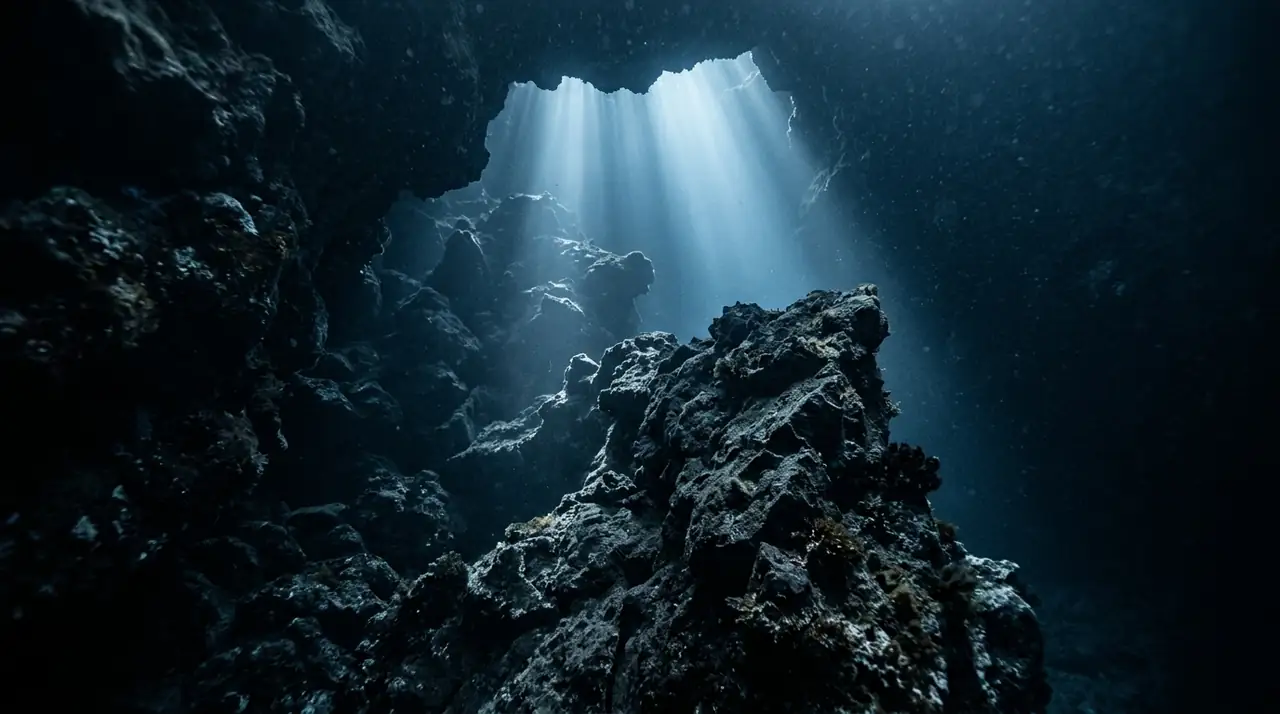
Huvadhoo Kandu
Overview
Huvadhoo Kandu is a deep channel cutting through the western rim of Huvadhoo Atoll, one of the largest and least-explored atolls in the Maldivian archipelago. Situated in the deep south, far below the well-trodden circuits of North and South Male, Huvadhoo operates on a different timescale. The currents that pulse through its channels carry the cold, nutrient-dense water that rises from the abyssal depths of the equatorial Indian Ocean, and with those nutrients come predators in numbers that recall the Maldives before mass tourism arrived. Our liveaboard anchored in the lee of the atoll rim on a February morning, the channel mouth visible as a gap in the reef flat where the water changed colour from turquoise to cobalt. The dive briefing was detailed and serious. The divemaster explained the current patterns, the hook-in points, and the absolute necessity of staying together. This was not a site for wandering. We entered on a moderate incoming tide, dropping quickly to the reef edge at eighteen metres and swimming against the current to reach a sheltered corner where a coral outcrop created an eddy. Here we hooked in and waited. The waiting was not long. Within three minutes, the first grey reef sharks appeared from the blue, a loose formation of six animals swimming directly into the current with an effortless economy of movement. They were followed by more. And more. Over the course of the dive, I estimated at least forty grey reef sharks patrolling the channel mouth, their numbers concentrated where the current accelerated through a narrow section of the channel.
Early access
Plan a dive here
Open the DiveOne planner to sketch a recreational plan before you go. It is a planning assistant, not a dive computer.
Marine life
Dive profile
DEPTH PROFILE
DEPTH PROGRESSION & WAYPOINTS: Huvadhoo Kandu
Location
Frequently asked questions
How do I get to Huvadhoo Kandu for diving?
Huvadhoo Atoll is accessed via a domestic flight from Male to Kaadedhdhoo airport, followed by a speedboat transfer to one of the few resorts or guesthouses in Gaafu Dhaalu Atoll. The flight takes approximately seventy minutes. Alternatively, liveaboard itineraries covering the deep south of the Maldives include Huvadhoo as a key stop, typically on routes running from Male to Addu Atoll over seven to ten days. Liveaboards offer the most flexibility for diving the channel as they can time entries to match tidal conditions. The remoteness is part of the appeal but requires advance planning, as dive infrastructure is limited compared to the central atolls.
What level of experience is needed for Huvadhoo Kandu?
Huvadhoo Kandu is an advanced dive requiring a minimum of fifty logged dives and comfort with strong currents. The channel can produce powerful tidal flows that require reef hooking or sheltering behind coral outcrops. Descents to the reef edge at twenty metres must be made quickly to avoid being swept into open water. The depth of the channel floor exceeds forty metres, and the most productive shark viewing often occurs between twenty-five and thirty-five metres, demanding good air management and awareness of decompression limits. A current hook is essential equipment. Divers should be comfortable with negative entries from a moving boat and experienced in current diving.
When is the best time to see hammerheads at Huvadhoo?
Scalloped hammerhead sharks are most reliably encountered at Huvadhoo Kandu during the northeast monsoon from January to April. The sharks tend to appear in the early morning on incoming tides, schooling in the blue water beyond the channel mouth at depths between thirty and forty metres. Sightings are not guaranteed but are frequent enough during this season to make dedicated trips worthwhile. The best strategy is to arrive at the channel before sunrise and position yourself on the outer wall where the current brings nutrient-rich water from deep offshore. Grey reef sharks are present year-round and are virtually guaranteed on every dive regardless of season.
Reviews
Reviews
No reviews yet
Data Provenance
This profile is compiled from 3 operator submissions and 142 community logs. Key facts (depth, entry) are verified against official hydrographic charts.