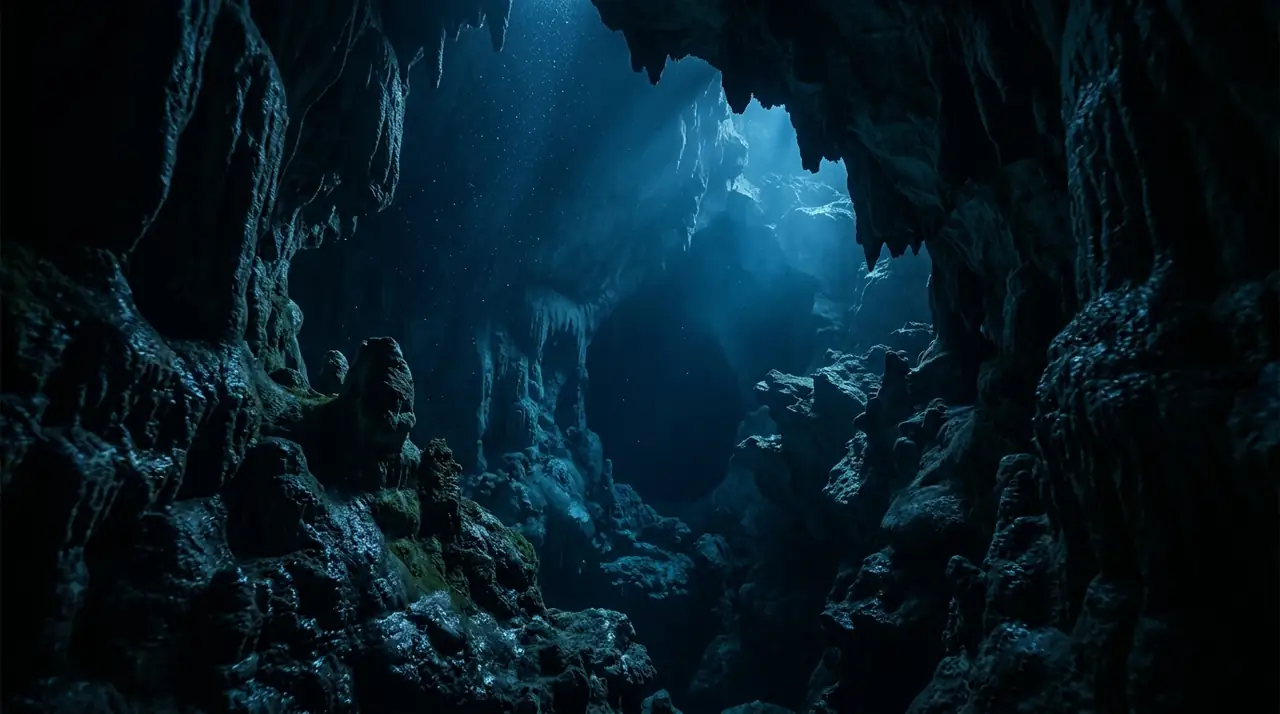
Hunga Ha'apai Underwater Cave
Overview
Hunga Ha'apai is a crescent-shaped volcanic island in Tonga's remote Ha'apai Group, its steep jungle-covered slopes rising sharply from an ocean that is absurdly blue even by South Pacific standards. The island is uninhabited, its only visitors the occasional fishing boat and the rare dive charter that makes the crossing from Pangai. What draws those divers is a system of lava tube caves formed during ancient eruptions, their seaward ends now submerged and accessible from the open water while their inland extensions rise above sea level into air-filled chambers lit by shafts of light filtering through the volcanic rock and jungle canopy above. I entered the water from the dive boat anchored off the island's western shore and swam toward the cliff base. The cave mouth was a dark arch in the volcanic rock at five metres depth, roughly four metres wide and three metres tall. The water inside was even clearer than outside, the lack of plankton and surge producing visibility that seemed limitless. I finned slowly through the entrance tunnel, my torch beam catching the rough texture of solidified lava on the walls, its surface folded and rippled in the patterns frozen from the moment the molten rock met seawater thousands of years ago. After thirty metres the tunnel opened into a chamber perhaps fifteen metres across and ten metres high. The bottom was a jumble of fallen lava blocks at twelve metres depth, and between them red soldierfish clustered in dense groups, their large dark eyes reflecting my light. A painted crayfish backed into a crack, its ornate purple and white patterning looking almost artificial against the dark volcanic rock. Above me the ceiling rose to an air dome, and when I surfaced inside, the sound changed completely: the rhythmic breathing of my regulator gave way to the drip of water, the distant crash of waves outside, and birdsong filtering down from the jungle.
Early access
Plan a dive here
Open the DiveOne planner to sketch a recreational plan before you go. It is a planning assistant, not a dive computer.
Marine life
Dive profile
DEPTH PROFILE
DEPTH PROGRESSION & WAYPOINTS: Hunga Ha'apai Underwater Cave
Location
Frequently asked questions
How do I access the Hunga Ha'apai caves for diving?
Hunga Ha'apai is a small volcanic island in the Ha'apai Group of Tonga, accessible by boat from Pangai on Lifuka Island. The boat trip takes approximately 30 to 45 minutes depending on conditions. There is no dock on Hunga Ha'apai so your dive boat anchors offshore and you swim to the cave entries. Only a few dive operators in the Ha'apai Group offer trips to Hunga, and advance arrangements are essential. The island is uninhabited and there are no facilities, so all supplies must come from Pangai.
What cave diving experience do I need for Hunga Ha'apai?
The main cave at Hunga Ha'apai is classified as a cavern dive rather than a full cave dive, meaning natural light is visible from most points inside. However, a cavern diving certification or cave diving introductory course is strongly recommended. The entries are large enough for comfortable navigation without tight restrictions, and the excellent visibility reduces disorientation risk. A minimum of advanced open water certification is required, and experience with overhead environment diving is important. Torches and backup lights are essential.
What is the best time of year to dive the Hunga Ha'apai caves?
The best diving conditions at Hunga Ha'apai occur during the dry season from May to October, when the southeast trade winds provide relatively calm seas and visibility is at its peak. The wet season from November to April brings heavier rainfall, increased run-off, and the possibility of tropical cyclones. Water temperatures remain warm year-round at 23 to 28 degrees Celsius. The humpback whale season from July to October is an added bonus as whales transit through the Ha'apai Group during this period.
Reviews
Reviews
No reviews yet
Data Provenance
This profile is compiled from 3 operator submissions and 142 community logs. Key facts (depth, entry) are verified against official hydrographic charts.