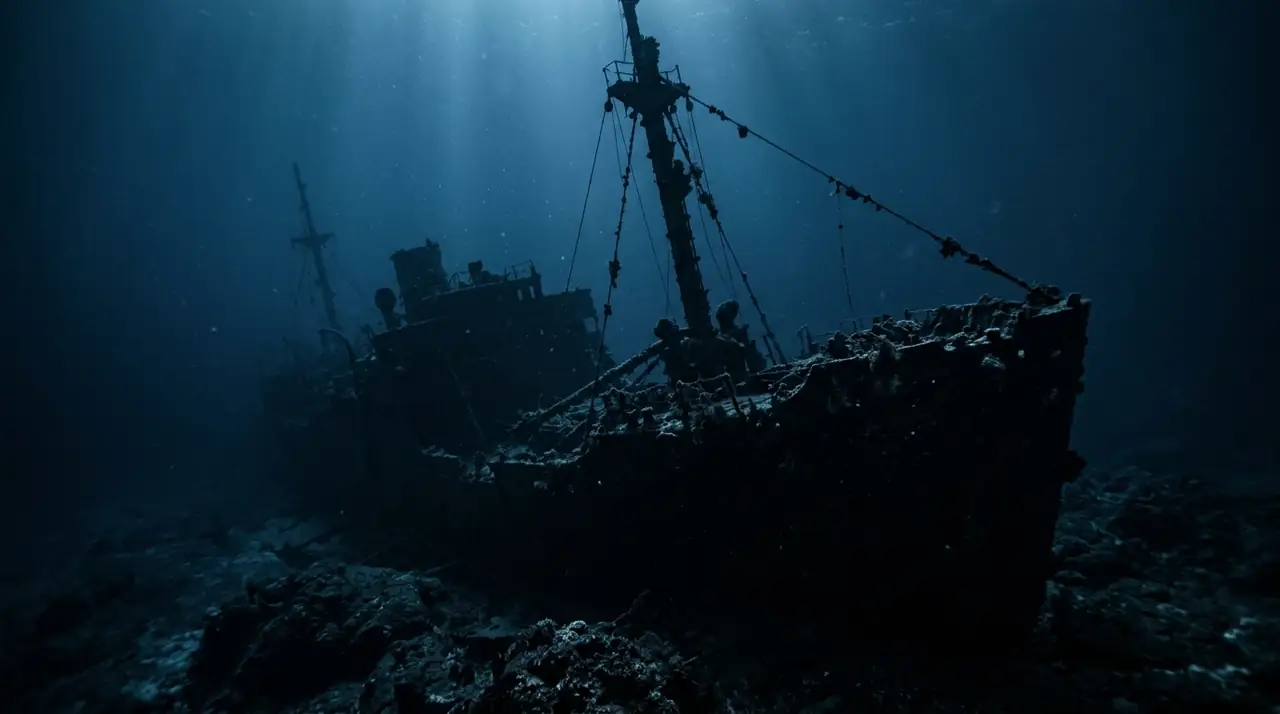
HMS Hermes Wreck
Overview
The HMS Hermes lies nine nautical miles southeast of Trincomalee, Sri Lanka, and diving her remains one of the most profound experiences I have had underwater. Launched in 1919 as the world's first purpose-built aircraft carrier, she served the Royal Navy before a devastating Japanese air attack on 9 April 1942 took her and 307 crew members to the bottom. Today she rests upright and largely intact, a silent monument to wartime sacrifice. The wreck is massive — 183 metres long, displacing over 10,000 tons. She sits on a flat sandy bottom at 54 metres, with the flight deck at approximately 47 metres and the superstructure rising to about 38 metres. Experiencing the wreck properly demands technical certification and decompression capability. As you descend and the dark silhouette of the carrier materialises below, the scale is genuinely overwhelming. Over eight decades of submersion, the Hermes has transformed into a thriving artificial reef. The superstructure is draped in soft corals, sponges, and hydroids. Giant groupers hover in the shadows of gun emplacements, batfish hang in disciplined formations along the hull, and barracuda patrol the perimeter. Moray eels and lionfish have colonised every opening. The flight deck, though silt-covered, retains a haunting geometry that speaks clearly to the ship's original purpose. Visibility varies between 10 and 25 metres, with the best clarity from April through September. Water temperatures are consistently warm at 27 to 30 degrees. Dive operators in Trincomalee offer guided technical dives, and the nearby wrecks of HMAS Vampire and a Fairey Swordfish biplane from the same attack make this area a wreck diving destination of global significance. The HMS Hermes is not just a dive; it is a pilgrimage into history.
Early access
Plan a dive here
Open the DiveOne planner to sketch a recreational plan before you go. It is a planning assistant, not a dive computer.
Marine life
Dive profile
DEPTH PROFILE
DEPTH PROGRESSION & WAYPOINTS: HMS Hermes Wreck
Location
Near Trincomalee, in the Eastern Province region of Sri Lanka.
Frequently asked questions
What certification do I need to dive the HMS Hermes?
Due to the depth of the wreck, with the deck at approximately 47 metres and the seabed at 54 metres, the HMS Hermes is classified as a technical dive. A minimum of Advanced Open Water with Deep Specialty is needed to visit the superstructure at 38 metres, but exploring the flight deck and deeper sections requires technical diving certification such as TDI Extended Range or equivalent, along with experience in decompression diving. Most operators require a minimum of 50 logged dives.
Is the HMS Hermes wreck penetrable?
Limited penetration of the superstructure is possible for certified technical divers with appropriate training and equipment. However, the wreck is a protected war grave under Sri Lankan maritime law, and removal of artefacts is strictly prohibited. Most recreational divers explore the exterior of the superstructure and flight deck, which offers abundant photographic opportunities. The wreck sits upright, which makes orientation relatively straightforward.
When is the best time to dive the HMS Hermes in Trincomalee?
The diving season on Sri Lanka's east coast runs from March through October, coinciding with the dry northeast monsoon period. The best conditions typically occur from April through September when the sea is calmest and visibility peaks at 20 to 25 metres. The southwest monsoon brings rough seas and poor visibility to the east coast from November through February, effectively closing the dive season.
Reviews
Reviews
No reviews yet
Data Provenance
This profile is compiled from 3 operator submissions and 142 community logs. Key facts (depth, entry) are verified against official hydrographic charts.