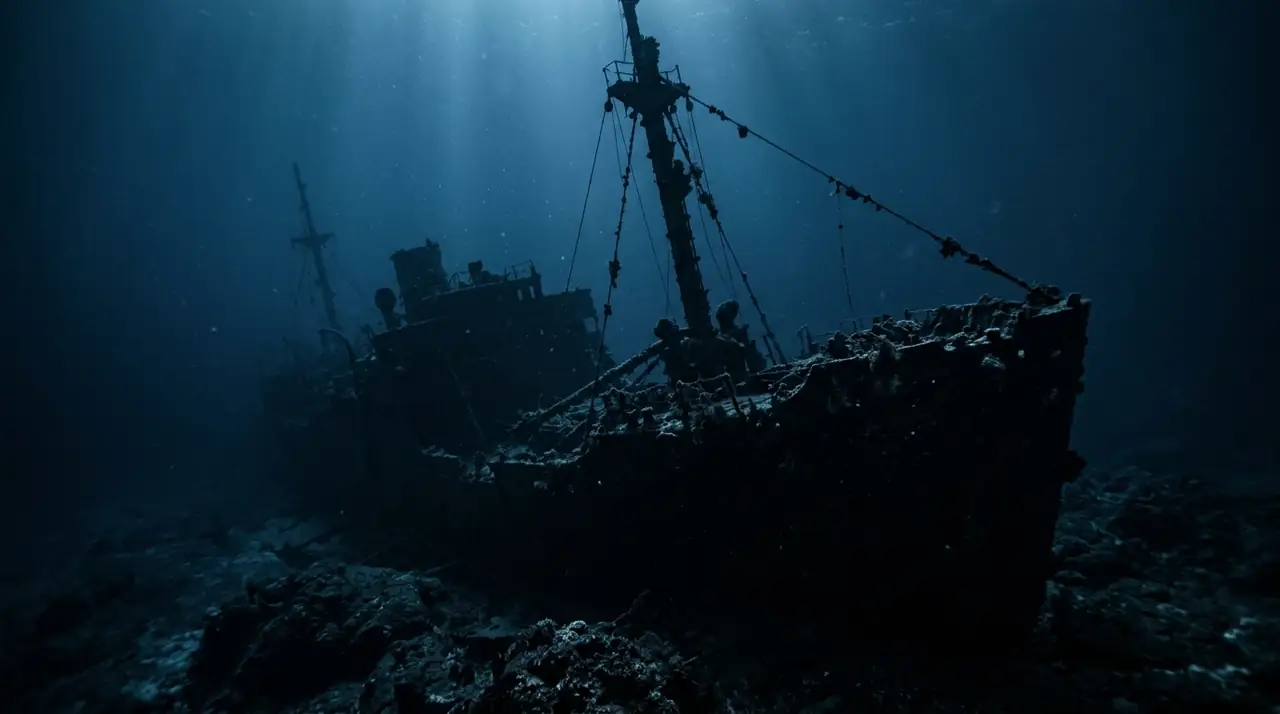
HMHS Britannic Wreck
Overview
The HMHS Britannic is one of the most significant shipwrecks in the world and arguably the ultimate technical wreck dive. Lying on her starboard side in 120 metres of water in the Kea Channel, she is the largest passenger ship on the seabed — at 269 metres, slightly larger than her famous sister, the Titanic. The Britannic was the third of the White Star Line's Olympic-class liners. Launched in Belfast in 1914, she never carried a single fare-paying passenger. World War One intervened, and she was requisitioned as a hospital ship. On 21 November 1916, while steaming through the Kea Channel to collect wounded soldiers, she struck a mine. Despite improved watertight compartments designed after Titanic's loss, she sank in 55 minutes. Thirty lives were lost, but swift evacuation saved over a thousand crew and medical staff. Descending the shot line into the deep Aegean blue, the wreck materialises from darkness at around 90 metres — first as a shadow, then resolving into the unmistakable profile of an ocean liner. The scale is almost incomprehensible. The hull stretches in both directions beyond visibility, encrusted with sponges and gorgonians swaying in gentle current. At this depth, every moment on the wreck is precious and costly in decompression time. The bow section is particularly dramatic, with forecastle and anchor chains clearly visible. Portholes stare out like empty eye sockets, many still with original glass. The warmer, less corrosive Mediterranean waters have preserved structural details long vanished from Titanic's remains in the North Atlantic. The wreck is a protected cultural heritage site requiring permits from the Greek Ministry of Culture. Only a handful of expeditions dive her each year. Diving the Britannic is a privilege reserved for those with the technical skills and preparation to reach her safely, an experience that redefines what wreck diving can be.
Early access
Plan a dive here
Open the DiveOne planner to sketch a recreational plan before you go. It is a planning assistant, not a dive computer.
Marine life
Dive profile
DEPTH PROFILE
DEPTH PROGRESSION & WAYPOINTS: HMHS Britannic Wreck
Location
Near Korissia, Kea, in the Kea Island, Cyclades region of Greece.
Frequently asked questions
Can recreational divers visit the HMHS Britannic wreck?
No. The Britannic lies at 120 metres depth, far beyond recreational diving limits. Only qualified technical divers with trimix certification, deep wreck experience, and expedition-level planning can access the site. Dives require multiple gas switches, lengthy decompression schedules, and specialised equipment. Additionally, a permit from the Greek Ministry of Culture is required as the wreck is a protected cultural heritage site.
What is the history of the HMHS Britannic?
The Britannic was the third and largest of the White Star Line's Olympic-class ocean liners, sister ships to Titanic and Olympic. She was launched in 1914 but never entered commercial service due to the outbreak of World War One. Requisitioned as a hospital ship, she struck a mine on 21 November 1916 in the Kea Channel while en route to collect wounded soldiers from the Gallipoli campaign. She sank in 55 minutes with the loss of 30 lives, far fewer than Titanic due to improved safety measures.
How was the Britannic wreck discovered?
The wreck was located by Jacques Cousteau in 1975 using his research vessel Calypso. Since then, several diving expeditions have explored the site, most notably those led by diver and historian Carl Spencer in the 2000s and 2010s. The wreck lies on her starboard side in remarkably good condition compared to the Titanic, as the Aegean Sea's warmer, less corrosive waters have preserved much of the hull structure.
Reviews
Reviews
No reviews yet
Data Provenance
This profile is compiled from 3 operator submissions and 142 community logs. Key facts (depth, entry) are verified against official hydrographic charts.