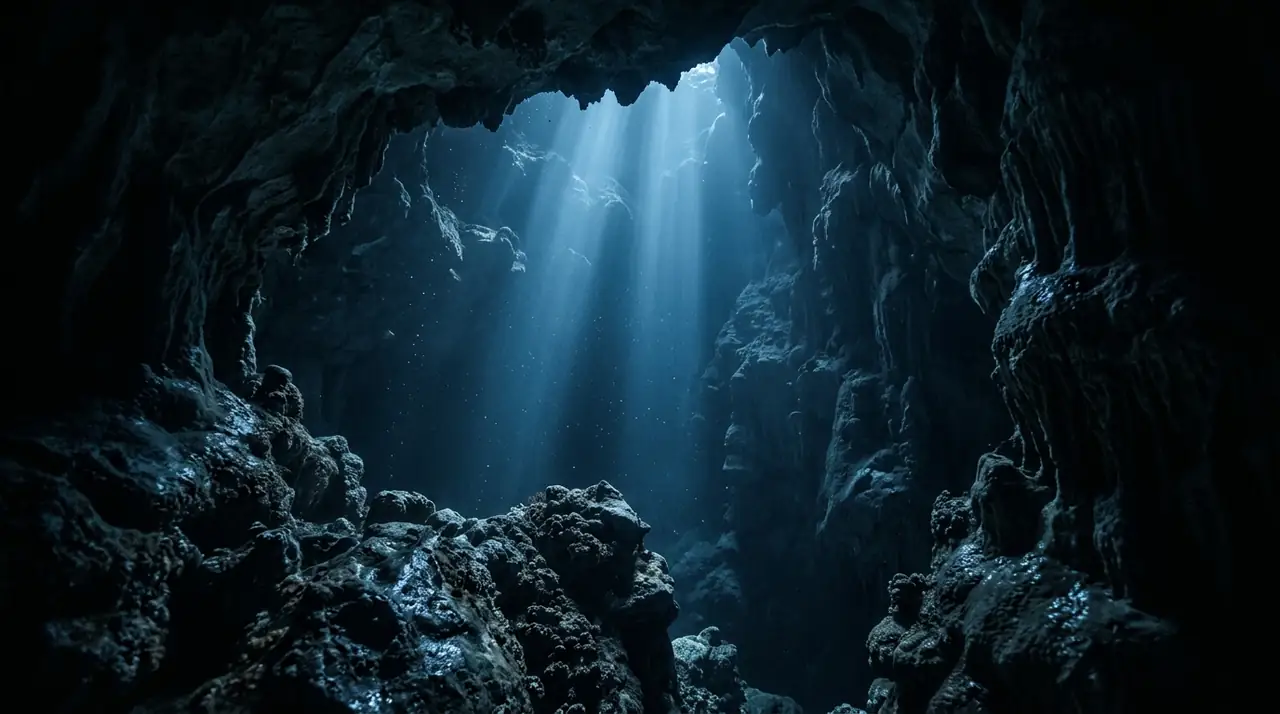
Cenote Calavera
Overview
Cenote Calavera sits in the jungle just two kilometres north of Tulum along the road to Coba, a deceptively simple hole in the limestone that opens into one of the Yucatan Peninsula's most photogenic underwater caverns. Known locally as the Temple of Doom, this cenote takes its primary name from its most striking feature: three circular openings in the ceiling that, when viewed from below, create the uncanny appearance of a human skull. It is a place where geology, light, and water combine to produce something genuinely magical. The entry is memorable in itself. Most divers use the largest of the three openings, a roughly two-metre diameter hole that requires either a giant stride into the water five metres below or a careful descent down a wooden ladder. The moment you surface inside the cavern and look up, the skull illusion becomes immediately apparent, two large eye sockets and a smaller nasal opening framing circles of jungle canopy and blue sky. I descended through the emerald shallows into the cavern proper, and the transformation was instant. Visibility opened to over thirty metres in water so clear it felt like floating in liquid glass. The limestone walls and formations took on a cathedral quality, fluted columns and scalloped surfaces carved by millennia of dissolution. Then the light show began. Late morning sun poured through the three openings in defined shafts, each beam a column of pure white cutting through the blue-green water. Suspended particles drifted through the beams like slow-motion confetti, and the effect was theatrical in the truest sense. At around ten metres I encountered the halocline, the boundary layer where fresh rainwater meets saltwater that has penetrated inland from the Caribbean coast. Swimming through this layer warps your vision like looking through old window glass, a surreal distortion effect that photographs beautifully but feels even more extraordinary in person. The cavern floor at fifteen metres is littered with breakdown blocks, fallen ceiling chunks colonised by a thin layer of sediment. Small freshwater fish, Mexican tetras and mollies, school in the light shafts, their silver sides flashing as they turn.
Early access
Plan a dive here
Open the DiveOne planner to sketch a recreational plan before you go. It is a planning assistant, not a dive computer.
Marine life
Dive profile
DEPTH PROFILE
DEPTH PROGRESSION & WAYPOINTS: Cenote Calavera
Location
Frequently asked questions
Why is it called Cenote Calavera or Temple of Doom?
The cenote earned its name because the three circular openings in the limestone ceiling, when viewed from underwater looking up, resemble the eye sockets and nose of a human skull. Calavera means skull in Spanish. The alternative name Temple of Doom comes from its atmospheric appearance, with jungle vines hanging through the openings and the dramatic contrast between the dark cavern and the bright shafts of light. Despite the ominous names, the cenote is relatively benign and suitable for intermediate-level divers.
Do I need cave diving certification to dive Cenote Calavera?
No, the standard dive at Cenote Calavera is a cavern dive that stays within the daylight zone, and any certified open water diver with some experience can participate when accompanied by a qualified guide. The maximum depth in the open cavern area is about 15 metres, and natural light is always visible. The cenote does connect to an extensive cave system, but entering the restricted passages beyond the cavern zone requires full cave diving certification, appropriate equipment, and extensive training. All cenote diving in Mexico requires a certified guide.
What is the best time of day to see the light beams at Cenote Calavera?
The most dramatic light effects occur between 10 AM and noon when the sun is high enough to send direct beams through the three overhead openings. The beams are most intense and well-defined during the dry season from November to April, when skies are clearer and the sun angle is optimal. Cloud cover significantly diminishes the effect, so choosing a sunny day is important. Arriving early in the morning avoids crowds but may miss the best light. Many photographers specifically target the 11 AM window for the most spectacular shots.
Reviews
Reviews
No reviews yet
Data Provenance
This profile is compiled from 3 operator submissions and 142 community logs. Key facts (depth, entry) are verified against official hydrographic charts.