Cenote Angelita Deep Profile
Overview
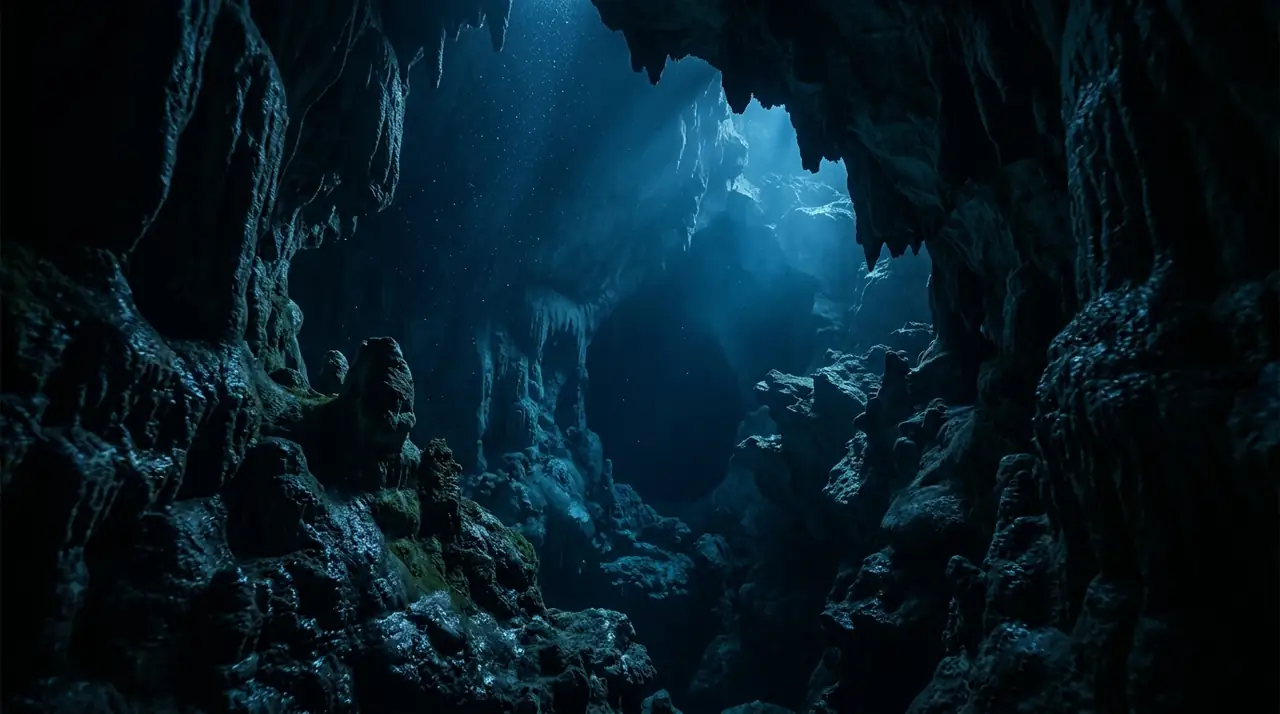
Cenote Angelita is known in recreational circles as a beautiful open cenote with submerged trees, but its true character reveals itself only to those who descend past thirty metres. Here, a hydrogen sulfide layer creates one of diving's most surreal phenomena: a dense white-grey cloud suspended in the water column, with dead tree trunks rising through it as though growing from a phantom forest floor. The cenote is a circular sinkhole fifty metres across, surrounded by jungle. Entry is via a wooden staircase to a platform where a giant stride takes you into clear fresh water. The first fifteen metres are pleasant cenote diving — dappled light through the canopy, roots hanging from the edges, freshwater fish in the shallows. At around twenty-eight metres, the water colour shifts. A yellow-brown tint thickens into an opaque layer — the hydrogen sulfide cloud, produced by decomposing matter at the density interface between fresh water above and salt water below. Dead trees that fell centuries ago stand vertically, trunks passing through this layer, branches above in clear water, roots below in salty darkness. Descending through the cloud is disorienting and primal. Visibility drops to less than a metre within the thickest section. Below, the water clears into saltwater — darker, heavier, inhabited only by bacterial mats. Tree trunks emerge from the sulfide mist like pillars in fog. At forty to fifty metres the experience is utterly alien. Looking up, the sulfide layer forms a ceiling resembling a stormy sky. Looking across, bare trunks stand in darkness like a submerged dead forest. The silence is absolute. Narcosis at this depth adds a dreamlike quality many divers describe as the most psychologically intense experience of their careers. This is not a dive for the unprepared. Gas management, deep diving experience, and comfort with darkness are prerequisites. But for those equipped, Angelita's deep profile delivers an experience existing nowhere else — a genuine journey into another world.
Early access
Plan a dive here
Open the DiveOne planner to sketch a recreational plan before you go. It is a planning assistant, not a dive computer.
Marine life
Dive profile
DEPTH PROFILE
DEPTH PROGRESSION & WAYPOINTS: Cenote Angelita Deep Profile
Location
Frequently asked questions
What certification do I need for the deep profile at Cenote Angelita?
The hydrogen sulfide layer begins at approximately 30 metres, which is at the limit of recreational diving. To properly experience the sulfide cloud and descend through it to the saltwater below, Deep Diver specialty or equivalent training is required at minimum. Many divers approach this as a technical dive with stages and decompression planning. Most responsible operators require demonstrated deep diving experience and comfort with overhead environment orientation.
Is the hydrogen sulfide layer dangerous?
The hydrogen sulfide cloud at Angelita is visually dramatic but presents manageable risks for prepared divers. The gas can cause disorientation and has a strong rotten-egg smell if it contacts your face. Brief passage through the layer is considered safe, but extended time within it is not recommended. The primary risks are narcosis at depth, disorientation from reduced visibility within the cloud, and the psychological impact of descending through what appears to be a solid surface. Proper briefing and guide support are essential.
How is the deep profile different from the standard Angelita dive?
The standard recreational dive at Cenote Angelita explores the freshwater layer above the halocline, reaching depths of 15 to 25 metres among the upper portions of submerged trees. The deep profile descends through the halocline and hydrogen sulfide layer to reach the saltwater below at 35 to 60 metres, where the landscape transforms into a surreal underwater world of bare tree trunks emerging from mist. The two experiences are fundamentally different in character and requirement.
Reviews
Reviews
No reviews yet
Data Provenance
This profile is compiled from 3 operator submissions and 142 community logs. Key facts (depth, entry) are verified against official hydrographic charts.