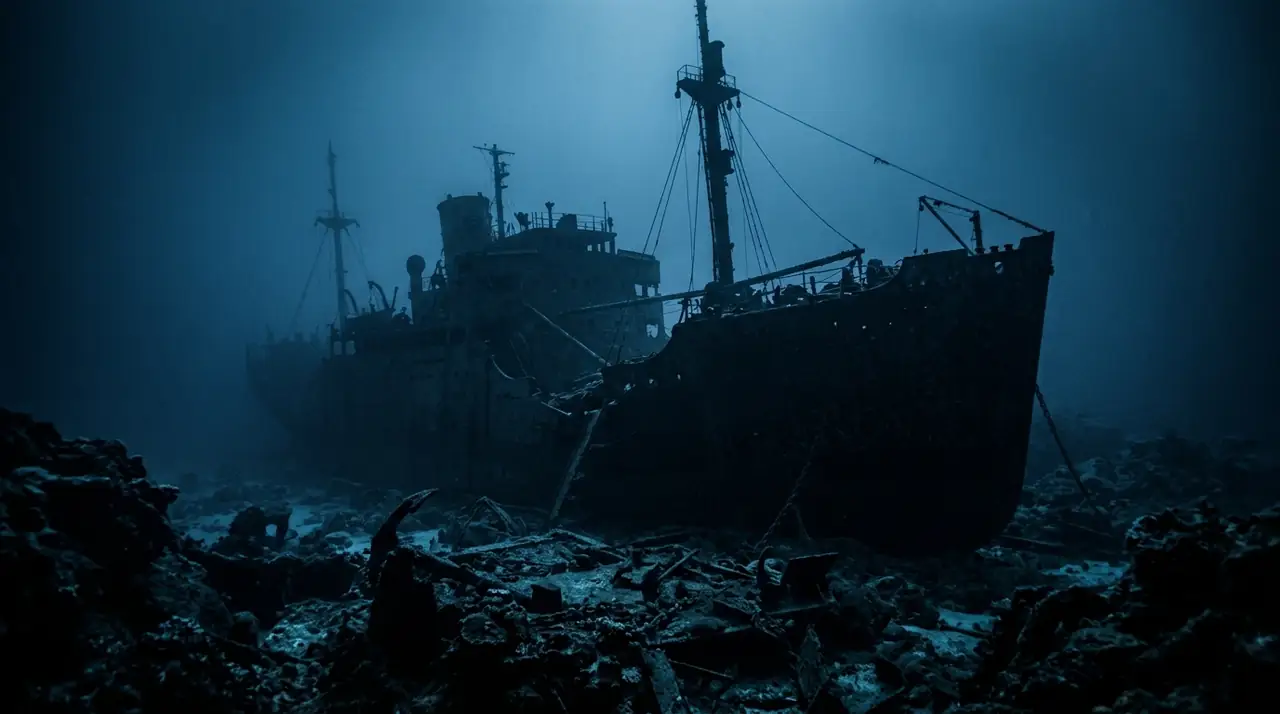
Labuan - Cement Wreck
Overview
The Cement Wreck is the star attraction of Labuan's renowned wreck diving portfolio, a 92-meter cement carrier sitting perfectly upright and remarkably intact in 30 meters of water east of Labuan Island in the South China Sea. Known officially as the MV Tung Hwang, this vessel sank on September 25, 1980, after striking Samarang Bank, and over four decades of marine colonization have transformed it into one of the most impressive artificial reefs in Malaysian Borneo. The wreck's dimensions are substantial. At 92 meters long and 15 meters wide, the Tung Hwang dwarfs most wreck dive sites in the region. The main deck sits at 19 meters, the wheelhouse at 14 meters, and the bottom of the hull rests on sand at approximately 30 meters. This depth profile means that even the shallowest meaningful features are below 14 meters, demanding good air management and buoyancy control. What sets the Cement Wreck apart is the extraordinary quality of its marine growth. The upper half of the vessel has developed into a genuine coral garden, with hard corals, soft corals, and sponges colonizing every surface. Sea fans extend from the railings, and the mast and rigging are festooned with colorful encrusting life. The transformation from industrial vessel to living reef is so complete in places that the underlying steel structure is barely visible beneath its biological coating. The fish life around the Cement Wreck matches the quality of the coral coverage. Massive schools of chevron barracuda form shimmering curtains above the superstructure, and large platoons of longfin batfish hover around the wheelhouse with their characteristic languid grace. Schools of snapper orbit the hull, groupers of impressive size occupy the darker interior spaces, and lionfish patrol the overhangs and doorways. Moray eels peer from hold openings, and stingrays rest on the sand beside the hull. Labuan's status as Malaysia's wreck diving capital rests on four significant wrecks, but the Cement Wreck is the crown jewel, combining accessible depth, excellent marine growth, impressive dimensions, and abundant fish life in a single dive. Combined with the warm waters and mild currents typical of the area, it offers a world-class wreck diving experience accessible to any intermediate-level diver.
Early access
Plan a dive here
Open the DiveOne planner to sketch a recreational plan before you go. It is a planning assistant, not a dive computer.
Marine life
Dive profile
DEPTH PROFILE
DEPTH PROGRESSION & WAYPOINTS: Labuan - Cement Wreck
Location
Near Labuan, in the Labuan Federal Territory region of Malaysia.
Frequently asked questions
What is the history of the Cement Wreck?
The Cement Wreck is the MV Tung Hwang, a 92-meter-long, 15-meter-wide cement carrier that sank on September 25, 1980, after hitting Samarang Bank east of Labuan Island. The vessel was carrying a cargo of cement when it went down, settling upright on the seabed at approximately 30 meters depth. The wreck is now one of four major wreck dives in Labuan's waters.
What certification do I need to dive the Cement Wreck?
Advanced Open Water certification is recommended as the wreck sits in 30 meters of water with the main deck at 19 meters and the wheelhouse at 14 meters. Open Water divers can appreciate the upper sections of the wreck but will have limited bottom time at the deeper areas. Wreck specialty certification is recommended for anyone wanting to explore interior passages.
How do I get to the Cement Wreck from Labuan?
The wreck lies approximately 13 kilometers east of Labuan Island, near Kuraman Island. The boat ride from Labuan town takes about 30 to 45 minutes. Several dive operators on Labuan Island offer daily trips to the Cement Wreck, often combined with one of the other wreck dives in the area. Labuan itself is accessible by ferry from Kota Kinabalu in Sabah or by air from Kuala Lumpur and Kota Kinabalu.
Reviews
Reviews
No reviews yet
Data Provenance
This profile is compiled from 3 operator submissions and 142 community logs. Key facts (depth, entry) are verified against official hydrographic charts.