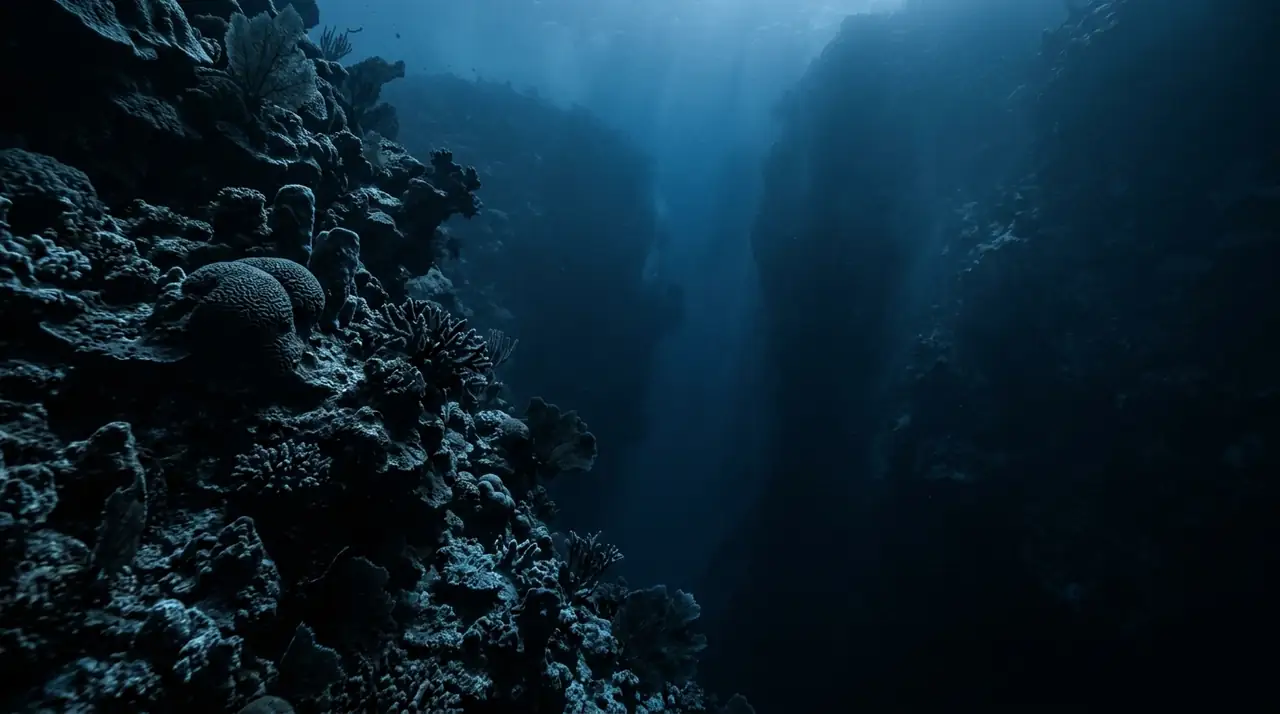
Blue Wall (Pared Azul)
Overview
San Andrés sits in the western Caribbean closer to Nicaragua than to the Colombian mainland that claims it, an island of limestone and coral surrounded by the world's third-largest barrier reef and protected within the UNESCO Seaflower Biosphere Reserve. The Blue Wall, known locally as Pared Azul, is the reef system's most dramatic dive site, where the barrier reef's outer edge drops vertically from a coral garden at eight metres into Caribbean blue. The wall runs along the island's western coast, and the dive begins with a backward roll into water whose clarity immediately explains the seven colours of the sea that San Andrés markets to tourists. Visibility routinely exceeds thirty metres, and the reef crest is a healthy garden of brain coral, elkhorn coral, and sea fans before the wall announces itself as a clean vertical drop. Descending the wall face, the sponge diversity is the first thing that demands attention. Barrel sponges in clusters of three and four anchor the ledges, their interiors the size of bathtubs. Rope sponges in vivid reds drape from overhangs. Tube sponges in electric yellow emerge from the wall in formations that look deliberately artistic. The sponge coverage on the Blue Wall rivals the best Caribbean sites, a reflection of the clean oceanic water that bathes the barrier reef from the deep Caribbean basin. Eagle rays are the reliable big-animal encounter. Spotted eagle rays cruise the wall face in ones and twos, their geometrically patterned wings spanning over a metre as they glide with effortless grace. Hawksbill turtles rest on ledges, their sharp beaks adapted to prying sponges from the wall. Caribbean reef sharks patrol the deeper sections, and nurse sharks doze in caves and overhangs throughout the wall. The broader reef system provides variety across multiple dive days. Inside the barrier reef, patch reefs and sand channels host French and queen angelfish, schools of yellowtail snapper, and cleaning stations where Nassau groupers queue for service. The reef flat supports seagrass beds with juvenile fish and rays, and shallow coral gardens offer unlimited macro photography opportunities. San Andrés has the advantage of easy access. Direct flights from Bogotá, Medellín, and several Central American cities serve the island daily. The dive industry is well established with multiple operators offering boat dives to the wall and barrier reef sites. The combination of world-class wall diving, UNESCO protection, warm Caribbean water, and Colombian culture creates a diving destination that delivers serious diving without the logistical challenges of Colombia's Pacific islands.
Early access
Plan a dive here
Open the DiveOne planner to sketch a recreational plan before you go. It is a planning assistant, not a dive computer.
Marine life
Dive profile
DEPTH PROFILE
DEPTH PROGRESSION & WAYPOINTS: Blue Wall (Pared Azul)
Location
Near San Andrés, in the San Andrés Archipelago region of Colombia.
Frequently asked questions
What is the Seaflower Biosphere Reserve?
The Seaflower Biosphere Reserve was designated by UNESCO in 2000 and encompasses the entire San Andrés Archipelago, covering approximately 65,000 square kilometres of Caribbean Sea. It protects the world's third-largest barrier reef system, extensive coral atolls, and the marine biodiversity corridor connecting Central and South American reef systems. The reserve includes core protection zones where fishing and extraction are prohibited, buffer zones with regulated activities, and transition zones supporting sustainable use. The Blue Wall sits within the barrier reef system protected by this designation.
How does San Andrés diving compare to other Colombian dive destinations?
San Andrés offers Caribbean wall and reef diving with warm clear water and excellent visibility, contrasting sharply with Colombia's Pacific destinations like Malpelo and Gorgona which are known for big pelagic encounters in cooler, current-swept water. Compared to Caribbean sites like Capurganá and Islas del Rosario, San Andrés has significantly more developed wall diving with greater depth range and sponge diversity. The barrier reef system is unique to San Andrés within Colombia and provides diving more similar in character to the Cayman Islands or Belize than to mainland Colombian waters.
What certification level is needed for the Blue Wall?
Advanced Open Water certification is recommended for the Blue Wall as the most interesting sections of the wall extend from 15 to 40 metres. The wall drops vertically, making depth management important. However, Open Water certified divers can enjoy the reef crest and upper wall to 18 metres, which still features excellent coral and sponge growth. Currents are typically moderate and predictable, running along the wall face. Most San Andrés dive operators offer guided dives with thorough briefings on current patterns and depth management for the wall.
Reviews
Reviews
No reviews yet
Data Provenance
This profile is compiled from 3 operator submissions and 142 community logs. Key facts (depth, entry) are verified against official hydrographic charts.