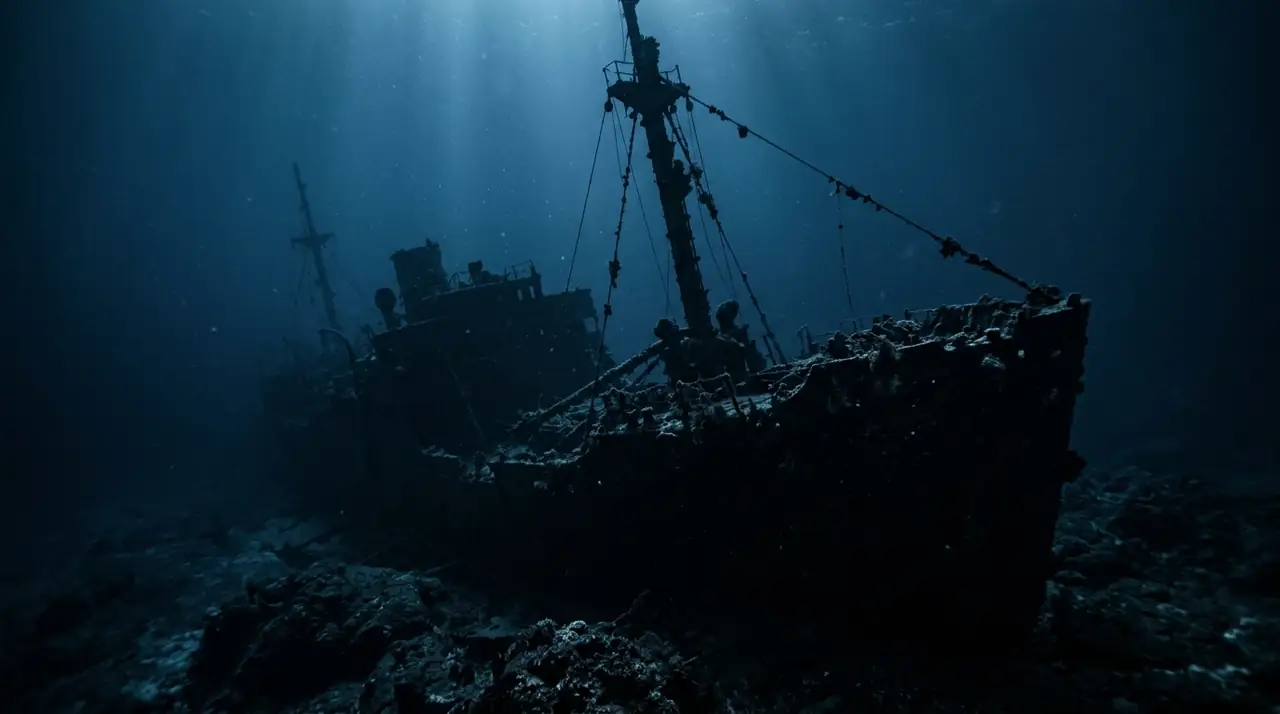
SS Baron Gautsch
Overview
The SS Baron Gautsch is Croatia's most famous wreck dive and one of the most impressive in the entire Mediterranean. This Austro-Hungarian passenger steamship met her tragic end on August 13, 1914, just days after the outbreak of World War One, when she struck a mine field near Rovinj while carrying passengers from the Dalmatian coast to Trieste. The ship sank rapidly, taking an estimated 150 to 390 souls with her into the depths of the Adriatic. Today the Baron Gautsch rests upright on the sandy seabed between 28 and 40 metres depth, her hull remarkably intact after more than a century beneath the waves. The ship stretches impressively across the seabed, and the first sight of her superstructure emerging from the blue-green gloom is genuinely breathtaking. Railings, portholes, davits, and deck machinery are all clearly visible, encrusted with sponges and colonized by anemones that have softened her angular lines into something almost organic. Conger eels have made their homes in the ship's passages, their heads protruding from every dark opening. Large schools of sea bream swirl around the upper decks, while scorpionfish lie motionless on horizontal surfaces, perfectly camouflaged. Lobsters occupy the deeper recesses, and nudibranchs of surprising variety crawl across the encrusted metalwork. The wreck acts as an enormous artificial reef, concentrating life from the surrounding sandy plain. Divers can explore the exterior of the ship extensively and penetrate the first two decks with an authorized guide. The bridge area and promenade deck offer the most photogenic sections, with natural light filtering through collapsed sections of the superstructure. For safety reasons, penetration beyond the second deck is prohibited. The Baron Gautsch holds protected national cultural heritage status, and diving is permitted only through authorized dive centres in Rovinj. This protection ensures the wreck remains intact and respected as both a historical monument and a war grave. Bottom time at 40 metres is naturally limited, making enriched air nitrox a popular choice among visiting divers. The boat ride from Rovinj harbour takes approximately 30 minutes, and conditions are generally best from June through September.
Early access
Plan a dive here
Open the DiveOne planner to sketch a recreational plan before you go. It is a planning assistant, not a dive computer.
Marine life
Dive profile
DEPTH PROFILE
DEPTH PROGRESSION & WAYPOINTS: SS Baron Gautsch
Location
Frequently asked questions
What certification do I need to dive the Baron Gautsch wreck?
A minimum of Advanced Open Water certification is required, with Deep Diver specialty recommended given depths reaching 40 metres. Wreck penetration beyond the first two decks is restricted. All dives must be conducted through authorized dive centres in Rovinj, as the wreck is a protected national cultural monument.
When is the best time to dive the Baron Gautsch?
June through September offers the best conditions, with warmer water temperatures of 18 to 24 degrees Celsius at the surface and visibility averaging 10 to 20 metres. Summer thermoclines can create dramatically different temperatures between the warm surface and the cooler wreck. Calm sea conditions are most reliable in July and August.
What is the history behind the Baron Gautsch wreck?
The SS Baron Gautsch was an Austro-Hungarian passenger steamship that struck a mine on August 13, 1914, just days after the outbreak of World War One, while sailing from the Dalmatian coast to Trieste. The ship sank rapidly, taking an estimated 150 to 390 passengers and crew with her. Today she stands upright on the seabed as a haunting memorial and one of the top wreck dives in the Mediterranean.
Reviews
Reviews
No reviews yet
Data Provenance
This profile is compiled from 3 operator submissions and 142 community logs. Key facts (depth, entry) are verified against official hydrographic charts.